
Monthly Archives

April 2010

Around Brooklyn, DUMBO, Profiles

Brooklyn Tech: Pontiflex CEO Zephrin Lasker

April 29, 2010

zephrin_laskerYou know you’re in Brooklyn, or more specifically in DUMBO, when the conference room at a hugely successful digital marketing and advertising firm is nicknamed “The Dude,” after Jeff Bridges’s immortal character in “The Big Lebowski.”

Pontiflex co-Founder and CEO Zephrin Lasker, 38,  exudes a similarly laid back vibe. Seated at The Dude’s conference table (bought on Craigslist), he seems at peace in their DUMBO office, which is essentially one large, white-walled room that glimpses the Manhattan skyline. Lasker and his jeans-clad employees are devoted to building, refining, and selling a unique online advertising concept called CPL, or cost-per-lead.

I had absolutely no idea what that meant, but it turns out I’m not alone. “How do I explain to my mom what I do?” a giggling Lasker said he often asks himself.

Despite the fancy moniker, CPL is a fairly no-nonsense approach to advertising. “We are building a system for advertising that lets advertisers buy ads, and only pay for those ads if someone opts in,” Lasker said, leaning back in his chair, hands clasped over his head.
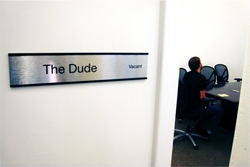
office_conferenceroomAn example: Pontiflex places ads for Huggies on a website like BabyCenter.com. Within the ad is a space to enter a valid e-mail address to sign up for a newsletter for moms. You see the ad, you sign up, Huggies pays, and never once do you navigate away from BabyCenter.com. Companies typically pay $1.25-$2.00 per sign up, but rates vary, and the fee for an ad is split between the host site and Pontiflex.

Cost-per-lead, or as Lasker calls it, cost-per-sign-up, differs from traditional advertising models where advertisers pay for eyeballs only. Pontiflex offers “contextual targeting,” meaning they place ads to sign up for the ASPCA on websites like Dogtime.com, where it’s safe to assume users are interested in animal rights.

The idea for this sort of advertising came to Lasker, a Red Hook resident by way of Baltimore and Chile, when he was working at big ad agencies in the early days of performance advertising on the Internet. But the technology required to implement Lasker’s plan wasn’t yet available.

With the help of “a really big tech team” and some venture capital, Lasker and his co-founders developed the data transfer engine they needed. Pontiflex launched in 2008, and is the first company to use CPL. Their system is in high demand by ad agencies and other institutions around the country, and Lasker claims they have no direct competitors.

“We’ve gotten big pretty fast,” he said sheepishly. “It’s a little scary.”

As for whether this brand-specific advertising model will ever be applied in other mediums, like television or radio, Lasker smiled coyly and said only that Pontiflex is doing some research that he can’t really talk about.

Having started two other companies, Lasker was familiar with the “boot camp mentality” of New York startups. “You get run over in the city pretty fast if you’re not progressive,” he said. “I think it forces you to really do a lot in very little time.”

Pontiflex, which tripled its revenue last year, certainly followed that ethos. So did many other DUMBO-based digital outfits, whose success Lasker attributes, at least in part, to their “blank slate” of a neighborhood.

Brooklyn, in his view, is “hip, but it’s totally scrappy,” much like startups themselves. “We’re not going to have wood paneled offices and drive around in fancy town cars,” Lasker continued. “It’s more entrepreneurial.”

Lasker is no tech-whiz, but he regards the “geek” stereotype as a badge of honor. “For me, it means you think kind of differently, you don’t necessarily fit in,” he said. “And with a startup, that’s great.”

Given the rampant optimism in his industry at present (as witnessed by this reporter and detailed in last week’s New York Magazine cover story), Lasker confessed there’s at least one negative aspect of this booming field.

“There’s a lot of hype,” he said. And while hype can be good, it can also lead to backlash. “You have to be careful. Sometimes there’s just a lot of smoke.”


Source: Brooklyn Heights Blog » Brooklyn Tech
http://brooklynheightsblog.com/archives/18024

From the Web

Around Brooklyn, DUMBO, Profiles

Brooklyn Tech: drop.io’s Steven Greenwood

April 19, 2010

bio-210x3001Steven Greenwood (@sgreenwood) rarely stops smiling when talking about drop.io, the two-year old, DUMBO-based company that, in a nutshell, powers content sharing online. It could be that Greenwood, who is 32, is enthusiastic about what he does as vice president of business development at drop.io, which recently spun off a service called PressLift that Greenwood created; or maybe he’s chipper because Brooklyn Borough President Marty Markowitz just announced that his office is going to start using PressLift for all of its media needs. Whatever the reason, Greenwood’s positive outlook on his industry is not only echoed by his peers, it is refreshing in an otherwise dour economic climate.

“We’re actively hiring!” he exclaimed, sitting in a Union Square diner sipping a soda on a recent evening.

Greenwood believes New York City is the epicenter of the next phase of the internet revolution. “We could not have built PressLift in any other city in the world,” he said. “We’re within a subway ride away from the top PR firms, the media companies, Madison Avenue, and big Fortune 500 companies who we can connect to in a single day.”

PressLift would not have happened without the success of drop.io, which Greenwood described as “a point of exchange on the internet.” Teachers, journalists, architects, and thousands of others use the site to create “drops,” a means of online file-sharing. The service is free up to 100 megabytes, after which point users pay for more space.

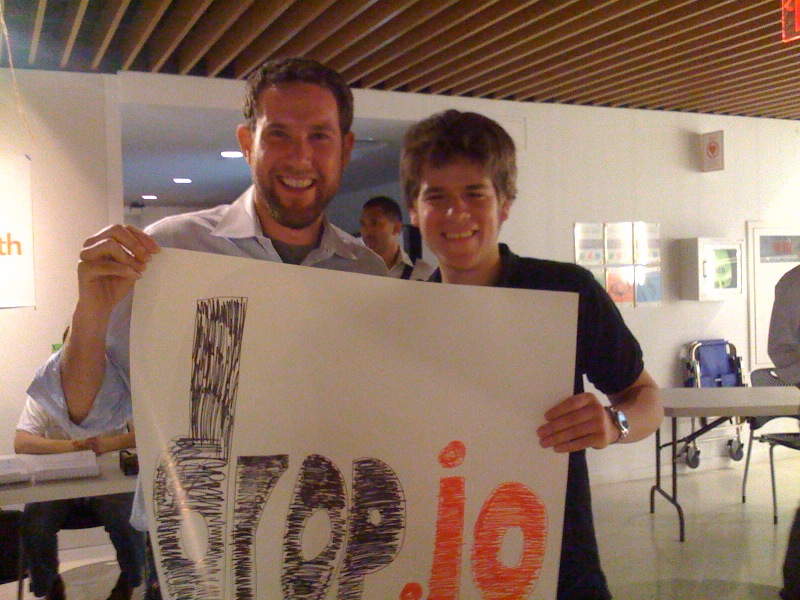
4-10-job-fair-photo-with-dropio-image

The benefit of drop.io for people working on a project together, for example, is that it streamlines communication. Instead of engaging in a long e-mail thread, each member of the team receives an alert when content is added to or changed in the “drop.”

“These are real time points of exchange,” said Greenwood, who lives in the East Village. It is drop.io’s responsibility, he added, to not only use their robust background to power content sharing, but to provide context and relevancy. “We’re building specific applications that are geared to specific users for certain uses.”

Case in point is PressLift, the genesis of which happened very organically. “Among the tens of thousands of users of ‘drops’ were communication professionals,” said Greenwood. “What they wanted to do was share multimedia with a press release—really, a very simple idea. It was actually really hard to do in practice.”

But they worked it out, creating a device for public relations professionals or press departments at places like the Borough President’s office to use to combine the text of a press release with associated video, audio, pictures, or links.

When asked why the Borough President’s office should use PressLift instead of simply creating their own page for that sort of content, Greenwood employed a helpful analogy.

“If you’re an individual company you constantly have a decision: do we buy a desk or do we build a desk?” he said. Using PressLift, which has access to the resources and talent from drop.io, is akin to buying the desk, because, Greenwood added, “We know content sharing really well.”

Drop.io/PressLift also works with Pepsi, Conde Nast, McGraw-Hill, and the Robin Hood Foundation, whose offices Greenwood was headed to later for a meeting, dressed predictably in—what else?—a zip-up hooded sweatshirt.

Greenwood sees DUMBO’s role as a breeding ground for digital start-ups much like some kids see Disney World. “It’s an area where you can imagine,” he said dreamily. “A lot of what we’re doing is trying to imagine where the future is.”

Though DUMBO is historically known for its population of artists, Greenwood doesn’t see himself or his contemporaries as all that different from their progenitors.

“This is a place that encourages and fosters ideas, and helps create this community that promotes them,” he continued. “That’s incredibly valuable, and it’s part of this ecosystem growing in DUMBO, and Brooklyn, and throughout New York.”

Drop.io will host the 15th Digital DUMBO meetup on Thursday, April 29, at their offices in, duh, DUMBO.


Source: Brooklyn Heights Blog » Brooklyn Tech
http://brooklynheightsblog.com/archives/17811

From the Web

DUMBO, Profiles

Brooklyn Tech: Purple Rock Scissors

April 5, 2010

308361Self-described techie “geeks,” like Aaron Harvey and Alex Lirtsman of the DUMBO-based firm Purple, Rock, Scissors, are really anything but. Though they’re dressed in the requisite hipster apparel—zip-up hooded sweatshirts, skinny jeans, sneakers—and toss around terms like “search engine optimization,” “conversion,” and “analytic platforms,” Harvey and Lirtsman probably have more in common with behemoth Madison Avenue advertising agencies than with their artistic Brooklyn neighbors. But that doesn’t mean they don’t fit in.

aaron_profile_short_

“We really saw this emerging scene here, and there was a lot of buzz, and a lot of excitement,” Harvey, 28, said about why PRPL set up shop on Jay Street when they expanded from Orlando, Florida six months ago. “That’s why we chose to come to Brooklyn and come to DUMBO, because it’s on fire right now from a tech perspective.”

As a digital marketing agency PRPL, which has just 15 employees, helps non-profit agencies and diamond jewelers alike figure out how to best position themselves to customers in a competitive online environment.

alex_teampicture“We have a pretty big discovery process where we break down specific goals,” said Lirtsman, also 28, the company’s chief marketing officer and a Kensington, Brooklyn native. “We don’t try to come up with one end-all solution, but try to touch upon those goals and create a strategy.”

That strategy can be anything from ensuring a client’s Facebook presence leads to an online sale to meeting fundraising or volunteering goals. They use proven channels like e-mail programs, newsletters, and social media to execute their plan, and measure which one leads to the most “conversions;” or, in laymen’s terms, which one achieves the goal.

Then they perform tests and analyze data to determine, for example, whether a user is more likely to convert when offered free shipping on purchases over $25, or when shipping is a flat $1.99 site-wide. “We’re constantly optimizing,” Lirtsman added.

PRPL optimized its own presence when it opened up its three-person operation in shared office space in DUMBO last fall. With a growing New York-based clientele that includes companies like Vizio, Better Home and Gardens, and the Jewish news site JTA, Harvey, a partner in PRPL and its chief operating officer, is enjoying the new atmosphere.

“It’s more experiential work, that’s the fundamental difference,” Harvey, who is from Florida, said about the New York market. In Orlando, much of their work involved maintaining clean, well-coded sites, while here, he said, “clients want to blend interactive campaigns with print campaigns to go after 200 coveted advertisers.”

“And they want it done yesterday,” Lirtsman chimed in.

Harvey and Lirtsman are nothing if not passionate about their jobs. They met as suitemates freshman year at the University of Central Florida, and began working together a few years ago when their mutual pal Bobby Jones founded PRPL, then called Hydra Studio, in his garage in 2002.

PRPL has grown quickly, Harvey believes, because of its approach. “We come from an e-commerce mindset, and that allows us to make sure that everything we do…is tied into a business goal, tied to a track-able event, tied into a key performance indicator that we establish to begin with,” he said.

But they juggle an intersection of three realms—business, art, and technology—that is common to most industries these days. “You kind of have these three different forces,” Harvey said. “While in some cases they can feel isolated, they kind of have to come together and bash their heads.”

Much like the DUMBO-based techies themselves, who, while often in direct competition with one another, are also fiercely collaborative. In just the last year, the Digital DUMBO monthly meetup ballooned from a few dozen people to what Harvey estimated was around 500 in March. From the PRPL perspective, which Harvey admits is limited, the draw of DUMBO for techies is more than just relatively cheap rent.

“Everybody in our industry is trying to say, ‘This is digital Silicon Valley,’ and there are people saying, ‘No, these are art spaces,’” said Harvey. “It’s a really cool, competitive environment. It’s up for grabs, and digital is grabbing it.”

And Purple, Rock, Scissors, for one, has no intention of letting go.

Brooklyn Tech is a new series devoted to digital businesses in DUMBO and other parts of Brooklyn.  Have a company in mind that we should profile?  Run one? E-mail us info AT the brooklynbugle.com


Source: Brooklyn Heights Blog » Brooklyn Tech
http://brooklynheightsblog.com/archives/17405

From the Web