Monthly Archives

May 2011

Music

Remembering Gil Scott Heron 1949 – 2011

May 28, 2011

Gil Scott-Heron, musician, has died at the age of 62.  He was best known for his seminal 1970 spoken word hit “The Revolution Will Not Be Televised.”   However it’s his influence on other performers – notably the hip hop movement that began in the mid 1970s  that will prove to be his legacy.

The release last year of his  first new music in 16 years — I’m New Here — was praiseworthy. While none of the tracks on that collection initially struck me as “Winter in America” or “The Revolution Will Not Be Televised” did back-in-the-day, the mere fact that after a few stints in prison (drug related) GSH comes back with a collection of new music worthy of multiple listens is astounding. No, strike that… it’s testament to the strength of his vision and creativity.

Gil Scott-Heron will be remembered as a National Treasure who should have had many more admirers. Perhaps in death, hundreds of new, younger fans will discover this American genius. Undoubtedly,  some of his followers notably Common and Mos Def who are totally conscious and vocal about the influence the man has had on their music will continue to spread the word.  As for his impact on Hip Hop, Heron told New York Magazine in 2008, “I ain’t saying I didn’t invent rapping. I just cannot recall the circumstances.”

The article also quoted Princeton’s Cornel West who said, “His example has been a profound inspiration to me and so many others, in terms of fusing the musical with the prophetic and being willing to take a risk or pay a cost in order to lay bare some unsettling truths with such artistic sophistication.”

NPR’s All Things Considered profiles Gil last year.

Alan Light profiled him for Mother Jones last year.
 

From the Web

Existential Stuff, News

Hipster Rides Scooter on BQE

May 25, 2011

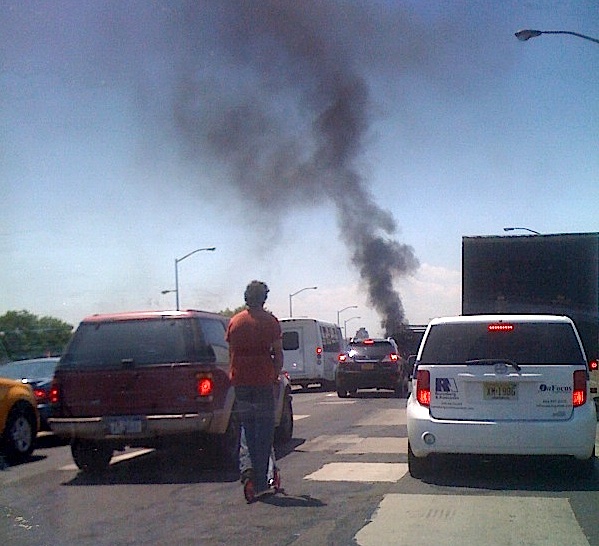
On our way back from Queens this afternoon around 1pm, we spotted a hipster on a scooter passing us on the right. Yes, traffic was crawling as usual. But still, what was a hipster (and another one ahead of him) rushing in that fashion on a major highway?

Turns out there was a car fire about 1/4 mile dead ahead of us and it appears they wanted to get some photos. FDNY was not on the scene yet but at least the two hepcats got to be the first to check-in from it on Foursquare errr sumthin’. And not for nuthin’ but if you see their pics online let us know!

From the Web

Books

Brooklyn Bugle Book Club: The Invention of Brownstone Brooklyn by Suleiman Osman

May 24, 2011

I’ve just started reading The Invention of Brownstone Brooklyn by Suleiman Osman.   In the book, the Park Slope native now an Assistant Professor of American Studies at George Washington University, explores “Brownstoners,” the group of new arrivals to Brooklyn  who in the mid 20th century renovated old tenements, flophouses and townhouses.   Characterizing them as “urban pioneers” or “gentrifiers” is too simplistic, Osman says, and his book delves into who this group really were and how they interacted with others in their new neighborhoods.

Have you read the book? Discuss in the comments below.

Deliberately Considered notes about the book:

The model set in Brooklyn Heights — meticulous attention to period architectural detail, the maintenance of unique small-scale neighborhood amenities, an emphasis on “local color,” etc. — soon spread to other areas of what was once called South Brooklyn. Those areas are now known by often manufactured neighborhood identities that leapfrog over twentieth-century urban development to retrieve an array of ostensibly pre-modern references, for example, Boerum Hill and Carroll Gardens, both named for imagined aristocratic founding fathers while at the same time evoking Brooklyn’s rural past. In the process, the brownstoners’ (as they still call themselves) ideal of incremental growth clashed with both the managerial impulses of the welfare state as well as the parochialism of urban machine politics. It is to Osman’s credit that in recounting this history he takes pains to objectively represent the positions of all parties, even the much-maligned Svengali of modern urbanism, Robert Moses.

Bookforum writes:

The book might surprise readers living in the Age of Bloomberg: As Osman tells it, the gentrification of Brooklyn was the work not of banks, developers, and speculators, but of a grassroots movement waging war against those very forces. The movement began as a neo-romantic quest for authenticity. As of the late 1940s, members of a highly educated postindustrial middle class (lawyers, teachers, editors, architects) began to discover the borough’s once grand but increasingly dilapidated Victorian neighborhoods. Fashioning themselves pioneers in an “urban wilderness,” they saw Brooklyn’s distinctive brownstone-fronted townhouses as refuges from their monolithically modern Manhattan offices. “In a kinetic modern city,” Osman writes, “brownstones were anchors, their heavy facades giving new white-collar workers a sense of rootedness and permanence in a transient urban environment.”

Excerpt from The Invention of Brownstone Brooklyn:

They first began to appear in Brooklyn Heights in the late 1940s. Artists, lawyers, bankers and other white-collar workers migrated to the aging Gold Coast district restoring old townhouses and moving into run-down tenements. By the 1960s, white-collar professionals priced out from Manhattan flooded into surrounding areas in search of cheap housing. “More and more people now are packing up, moving out of their aseptic uptown apartments,” explained New York about “brownstone fever” in 1969, “making new homes out of old, forlorn but solid and roomy brownstones, restoring them to pristine glory.”

As brownstoners spilled past the boundaries of Brooklyn Heights, they created new names for revitalizing blocks. “Cobble Hill” was named in 1958. “Boerum Hill” and “Carroll Gardens” soon followed. By the mid 1970s, few people remembered the name South Brooklyn. In brochures, newspapers, and real estate guides, the area had become “Brownstone Brooklyn” – a constellation of revitalized townhouse districts like Clinton Hill, Park Slope and Prospect Heights.

Brownstoners, however, believed they were involved in something more than a renovation fad. “Brownstoning,” as they called it, was a cultural revolt against “sameness,” conformity and bureaucracy. In a city that was increasingly technocratic, Boerum Hill was a “real neighborhood,” a vestige of an “authentic community” lost in a modernizing society. “On Wyckoff Street, an eccentric block of three-story workmen’s cottages have been rescued by young homemakers and turned into a happy, house-proud community,” described The Boerum Hill Times in 1974. “Indeed it’s quite possible to feel, while walking tree-lined streets, that one has broken through the time barrier and landed smack in the middle of the 19th century. Gentle ghosts of ladies in hoops skirts and gentlemen in frock coats can almost be seen among the leafy shadows.” (more)

From the Web

Profiles

Jesse Levitt’s Brooklyn Babies: Minor Arcana and Kings County

May 24, 2011

Jesse Levitt is almost everything the owner of two hip Brooklyn bars ought to be: offbeat but serious; nerdy but good-looking; creative but down-to-earth. The one thing he lacks, almost entirely? Ego.

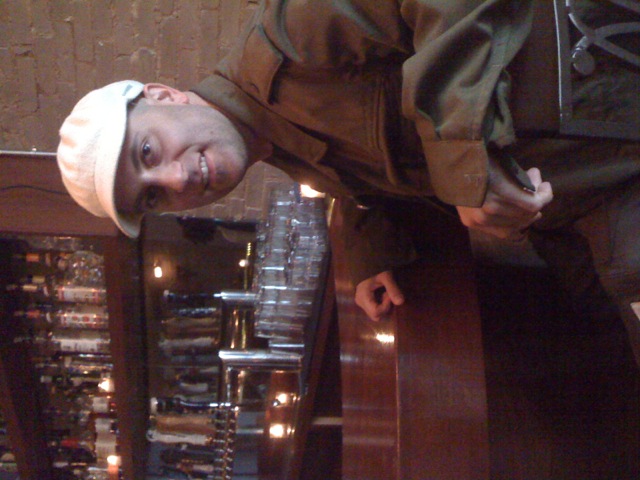
Seated in a wooden booth (that sometimes doubles as a stage) in his Prospect Heights watering hole Minor Arcana, Levitt, wearing a green, army-style jacket lined with outspoken pins, commanded nothing like a scary “I’m the boss” vibe on a recent Wednesday evening.  Rather than tout the success of the Coney Island-themed Minor Arcana and his other bar Kings County, in Bushwick, Levitt, who moved around a lot before landing in New York City 18 years ago, was brutally honest about the pressures of owning two bars.

“People think I sit around and drink beer all day,” he said, smiling. Minor Arcana does offer 12 brews on tap, but in reality, Levitt’s life sometimes more closely resembles that of a new parent. “You can never really 100 percent just relax, because some issue could come up at any time. I’m always on call.”

In between worrying about emergencies, Levitt manages to make Minor Arcana and Kings County comfortable, low-key, funky places to grab a drink (or four); take in a burlesque show; enjoy a 2-for-1 happy hour between 4-8pm, and also from 12-2am; or partake in a weekly trivia competition. He’s also kicking off a new party at Minor Arcana on the second Thursday of every month, called Tranz X. It will feature go-go boys and “boy-lesque” performances, and will be, Levitt thinks, one of the only bar events for the gay community in Prospect Heights.

His goal as a bar owner, he said, is simply to keep his establishments “an honest place to have a good time,” and he’s not worried about Minor Arcana being seen as one particular kind of bar or another. “If it’s thought of as a gay-friendly bar, that’s fine with me,” Levitt said.

He thinks that holding numerous events helps his bars stay relevant, and is one of many lessons he’s learned in the three-and-a-half years since he left the finance world to take over Kings County from its previous owner.

“It was like a private club for this guy and his friends,” Levitt said, noting that it has a decidedly different vibe from Minor Arcana. And though both of his bars are in up-and-coming hipster enclaves, Levitt insists he’s not riding any sort of trend. “I like this area because when I first started evaluating places, there were only half the number of bars that are here now,” he said of Prospect Heights.

As Minor Arcana approaches its first anniversary, Levitt reflected on the run-up to its debut, and one ominous trip to a Coney Island fortune teller. “She told me not to open this place, and to hold off,” he said. “I went ahead and did it anyway.”

And did it with a Coney Island theme, to boot; not tempting fate, exactly, but rather as an homage. “Coney Island is a timeless—at least for New York City—place to go and have fun,” Levitt said.

In a way, that’s what he’s tried to create in Minor Arcana. The space is small but ample, with deep lavender walls covered by a handful of framed, retro-style Coney Island advertisements. The bathroom, adorned with rows of tarot cards, is a tribute to Levitt’s (so far) inaccurate fortune, and to the bar’s name: in tarot readings, the minor arcana cards represent the concerns, activities, and emotions of everyday life.

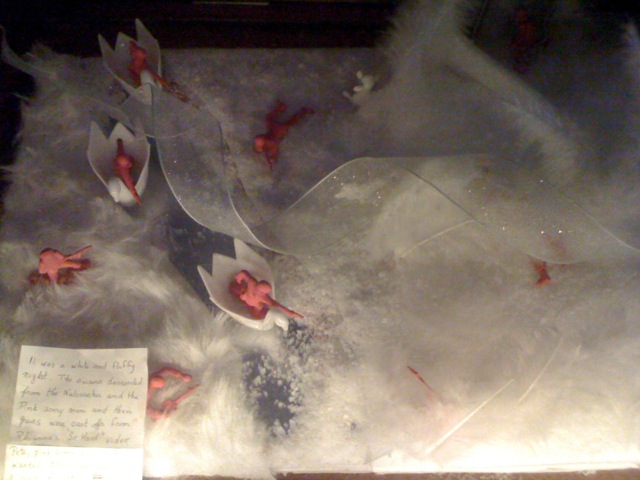
But the real treat at Minor Arcana is its custom-designed, shatterproof glass bar containing a series of dioramas that can be viewed and enjoyed from above. That the rotating, miniature art installations have stirred conversations and debate is no accident, because despite his passive demeanor, Levitt’s thoughtful, even-keeled fingerprint is all over his establishment.Be on the lookout for Levitt and his understated kitsch at this year’s annual Coney Island Mermaid Parade on June 18, which, as luck would have it, coincides with Minor Arcana’s one-year anniversary.

“We’re going to sponsor a float, and have an after-party at both bars, with a shuttle bus between both bars, with a bartender and go-go dancers,” he said, getting excited, both at the idea of a party and of shoving it in fate’s face.

And why not? After all, Levitt’s only regret, he says, is probably similar to that of his many loyal patrons: “Probably those times I’ve had too much to drink,” he said, soberly.

From the Web

Music

Brooklyn Bugle Sessions: MyNameisJohnMichael

May 23, 2011

The first question most interviewers ask John Michael Rouchell of the band MyNameisJohnMichael, usually, is about the 52 songs he wrote in a year on a dare. Sure it’s interesting but the primary reason for the initial salvo is the fact that it’s in the first paragraph of his official bio:

MyNameIsJohnMichael is a 6 piece indie rock band born and raised in New Orleans, which began as a solo project in 2008 when lead singer John Michael Rouchell accepted a friendly challenge to write, record, and release 52 songs in one year.

Easy question and lazy journos aside, it opened up a broader conversation about songwriting during our Brooklyn Bugle Session interview.  For example, in a week where the biggest karoke competition on the planet is about to crown a new American Idol it begs the question, “is songwriting dead?”

“I ask myself that question every morning.  I worry a lot that the concept of the song is dead, that it’s antiquated that people don’t care about stories.”

As a performer, John Michael presents as a mix of Elvis Costello, Joe Cocker, Billy Bragg as channeled by Thom Yorke. Out of all those, it’s Costello who appears to have influenced Rouchell’s wordplay the most — especially in songs like “Her, I Think” and his latest single, “Orphan”.

Rouchell readily admits to being a fan of Costello’s and has the singer’s TV show, Spectacle,  to thank for inspiring him to write one of the songs on 52.

Lou Reed discussed songwriting on the program and the flack he received for the dark themes he explored on his seminal album Berlin. Reed’s take on his choice of subjects, Rouchell says, “if Shakespeare can do it why can’t I?”

And that’s when he decided, “I’m going to kill someone off in a song. This is gonna be great.”  The result – the final song on 52Althea and the Company Store“, which took him 10 minutes to write.  However, it’s the one that sticks with him the most from that year of writing.

Diving deeper into the Costello connection, it’s his 1983 album Punch the Clock (which featured legendary jazz trumpeter Chet Baker) that is the most sonically similar to MyNameisJohnMichael. Makes sense since a key component of the band is its horn section.

John Michael says the idea for brass came from a conversation with  band producer Raymond Richards.   He wondered, what sonic element would  ground the band’s music in New Orleans and give it  a sense of place, much like Dylan’s harmonica puts you in 1960s Greenwich Village or  Clarence Clemmons’ sax roots Springsteen’s music in New Jersey?

“Brass. It was the color I grew up hearing,” Rouchell says. “So it just made sense.”

Stripped down to guitar and vocal for our Brooklyn Bugle Session Rouchell performs  “When I’m Older”. This intimate performance gives the song, which Rouchell says is more of a pop tune on record, a bittersweet spin.

Rouchell  says he’s “insanely proud” of the band’s untitled new album, out later this year, which mixes classic New Orleans R&B with indie and the band’s anthemic trademark sound.

From the Web

Arts and Entertainment, Food

Toasting The Rapture: Brooklyn’s Best Bars for Drinking Away The End-Times

May 18, 2011

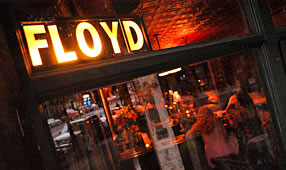
Floyd (world'sbestbars photo)

Yes, it’s true, friends: the world may or may not come to an end this weekend. Apocalyptic prophets have foreseen the Judgement Day, and it is Saturday, May 21st. But I have a dinner date on Sunday! Oh, the horror.

As we while away our last precious hours on Earth, it is, of course, appropriate that we turn to the drink. I surveyed local bartenders and their customers to see where, given our limited time, they would head for a bourbon-soaked view of the end-times.

Local tiki parlor Zombie Hut (273 Smith Street) was a popular choice, and as local barmaid Liz says, “if the rapture involves actual zombies there will be plenty of 151 to light them on fire.” Ms. Lord also pointed out that Floyd (131 Atlantic Avenue) would make sense, because “we should be able to throw big heavy balls at windows and cars when the end happens.”

Beyond the need for implements of riotous destruction, most of those polled chose a cozy neighborhood spot for a final evening with loved ones: an ice-cold martini at Minibar (428 Court Street), a night of Kensington karaoke at Shenanigan’s (802 Caton Ave), or finger food and fine cocktails at Sample (152 Smith Street).

Steve Reynolds

Local DJ Steve Reynolds chose Great Lakes (248 Fifth Avenue), where he “spent a large chunk of the night of 9/11 getting my drink on because, well, it felt like the end of the world. And they don’t have a TV, so you’ll never see it coming.” Mr. Reynolds also hosts the “Party Like It’s 1999” monthly dance party this coming Friday 5/20 at The Bell House (149 Seventh Street) – dancing your booty off seems like a nice way to go out (and speaking of booty, we hear the party is a rockin’ singles scene!).

And for Saturday, that (potentially) final day, where we will (possibly) be judged for our transgressions and/or be whisked away with angels (unlikely), we might as well add to our sins checklist with a night out at The Loft at Public Assembly (70 North Sixth Street). Saturday night the space is host to The Subway Soul Club – nothing like some down and dirty soul music to prepare your soul for The Rapture!

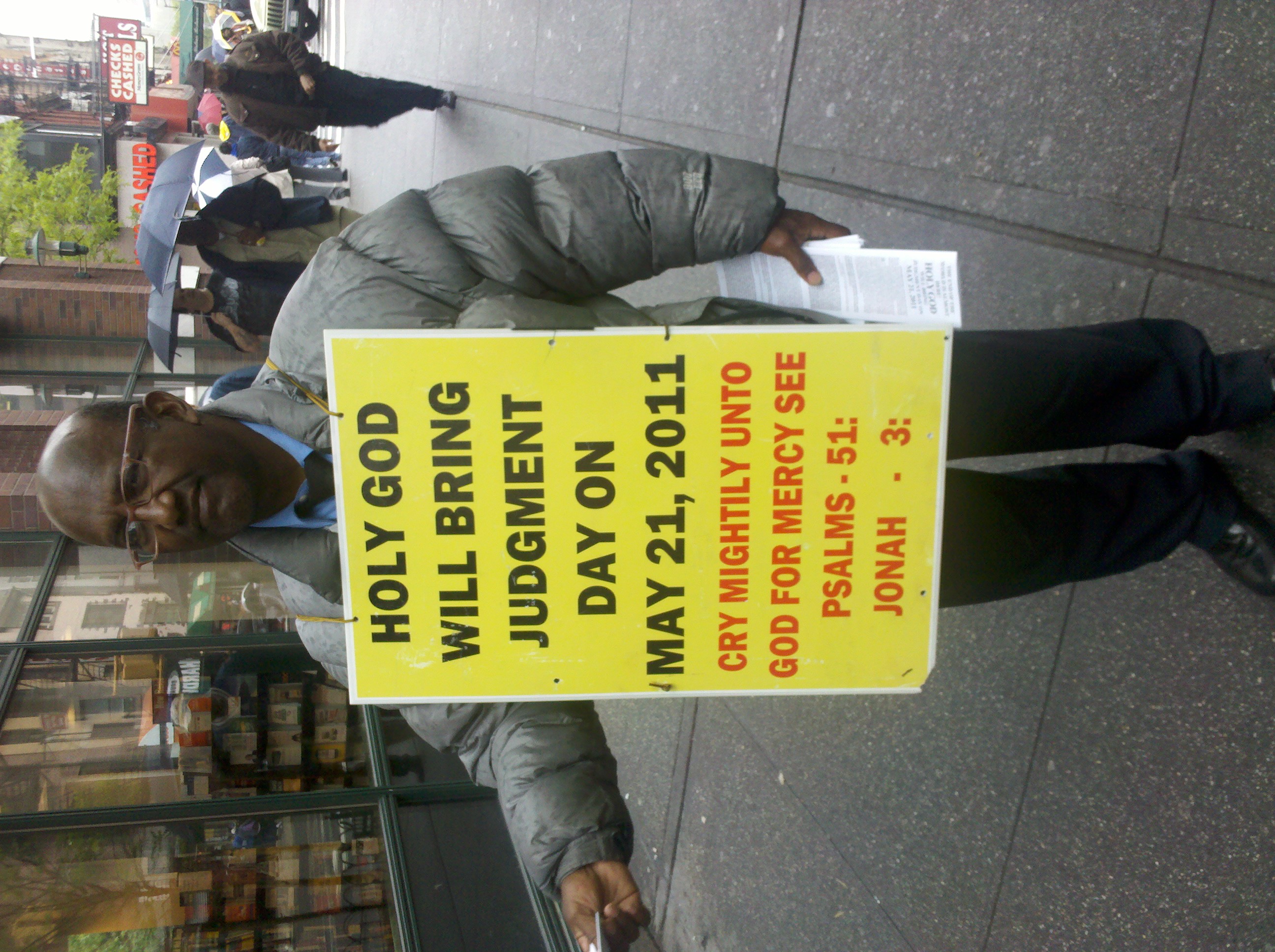
Here in downtown Brooklyn, the streets are filled with seers and soul-seekers shouting warnings and pamphleting the passing masses. I noticed this sign yesterday which had a personal touch to it (being that I’m named after the book in the Bible):

Now, I know my Old Testament, so I checked out Chapter Three of The Book of Jonah. This is the passage in which Jonah delivers God’s message that the people of Nineveh must change their ways or be destroyed. The chapter noted on the sign ends with the following (from The New International Version):

When God saw what they [the Ninevites] did and how they turned from their evil ways, he relented and did not bring on them the destruction he had threatened.

So… I guess what you’re saying is, we’re in the clear if we turn from our evil ways?

Maybe this list isn’t the best idea – but of course you should all feel free to enjoy the apocalypse as you see fit.

Hopefully I’ll see you on Sunday.

From the Web

Arts and Entertainment

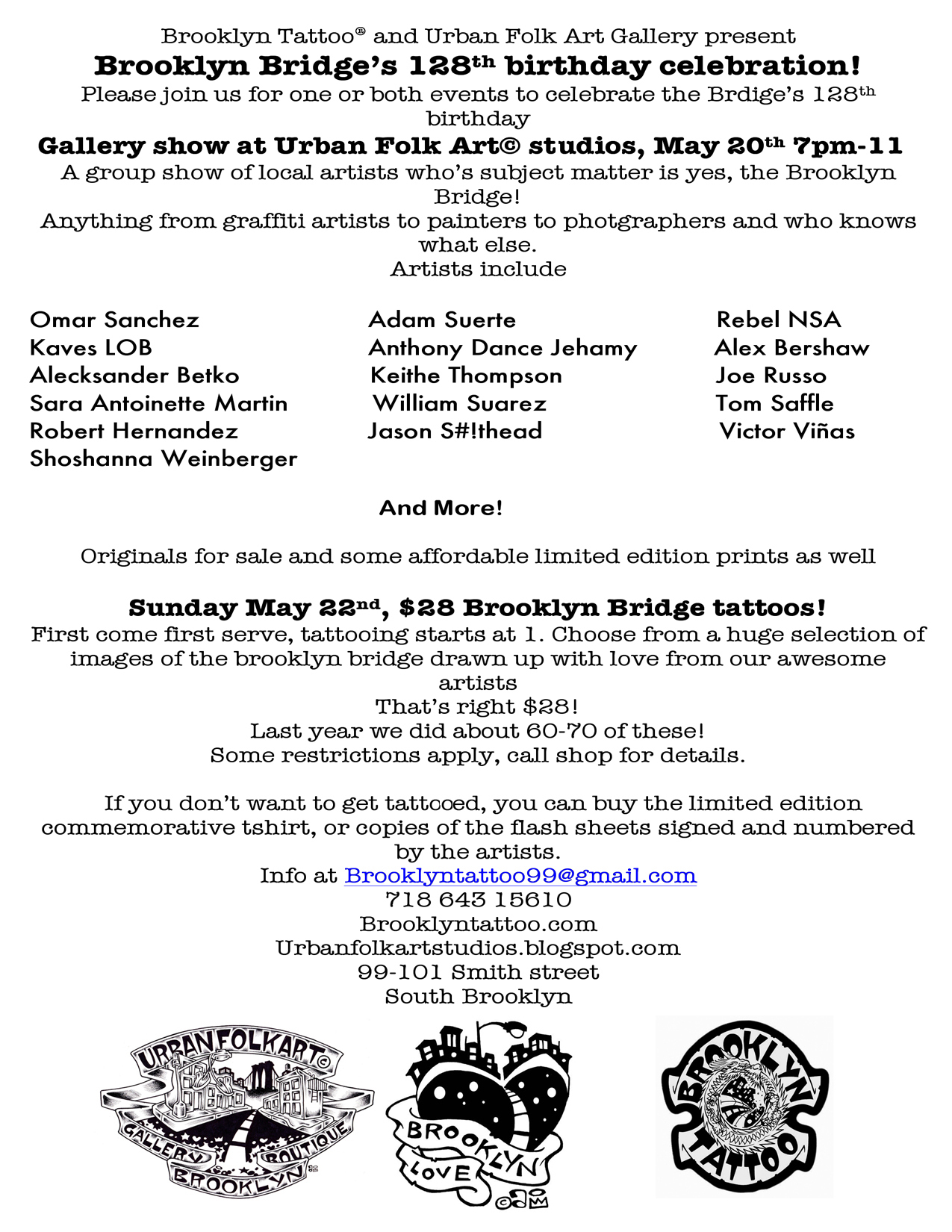
It’s Back! Brooklyn Bridge Tattoo Special

May 9, 2011

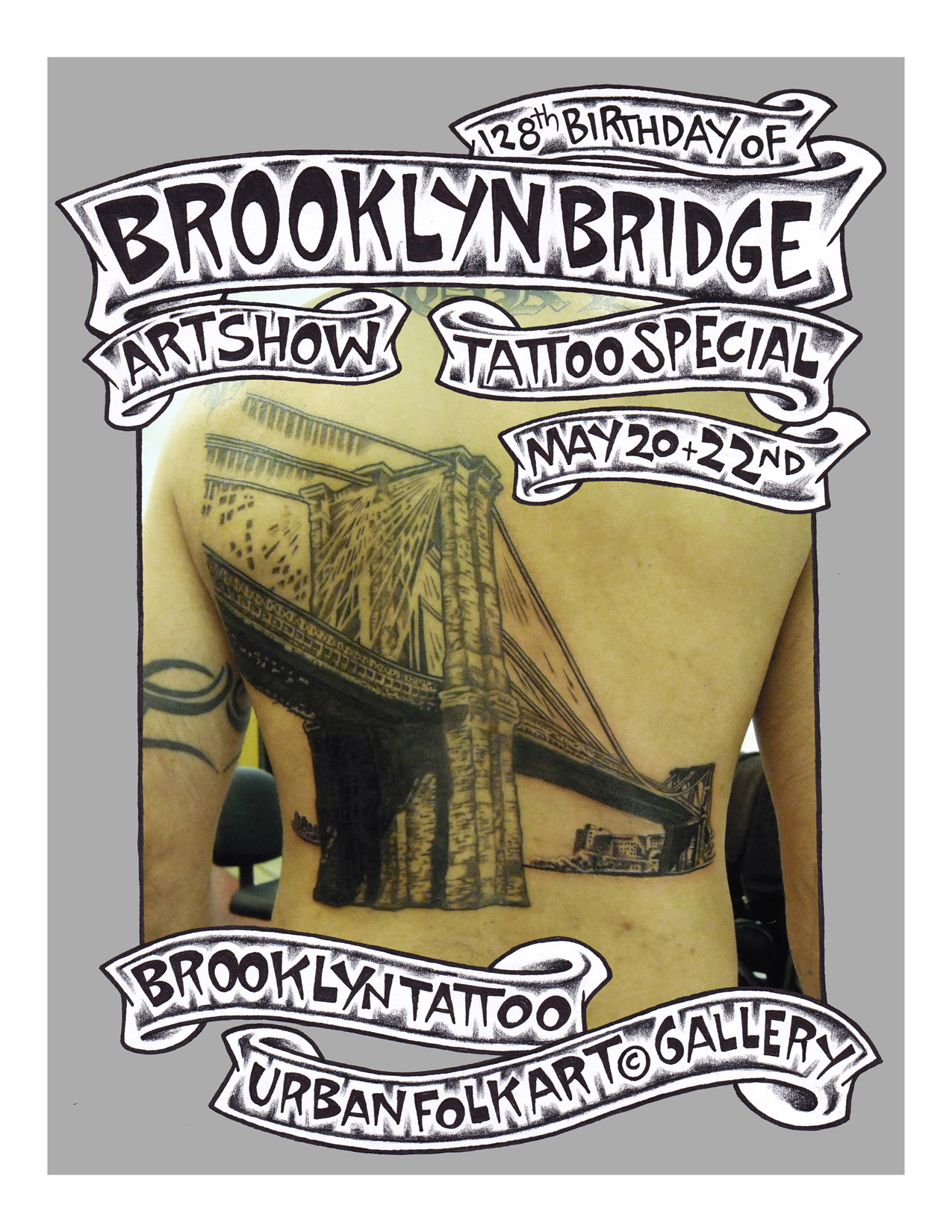
On May 22,  folks at Brooklyn Tattoo [99 Smith Street] will be offering $28 Brooklyn Bridge Tattoo special to celebrate the historic span’s 128th anniversary.

The stunt started last year and was so successful they’ve decided to do it again.

Brooklyn Tattoo’s Adam Suerte comments via press release, ”We had a great time last year tattooing between 60-70 bridges on prideful residents of the County of Kings, and fans of the Bridge. I tattoo at least a half dozen Bridges on people every month, I would say it’s the most tattooed homage to Brooklyn and NY there is.”

This year adding to the festivities will be an accompanying art show at newly opened Urban Folk Art Gallery on May 20 from 7pm to 11pm.

If you’re not the tattooing type, there will also be signed and numbered “flash sheets” of this years designs available for purchase as well as commemorative t-shirts.


From the Web