Monthly Archives

November 2011

Events, Tech

Mingle with the Brooklyn Bugle and Discuss Social Media December 14 in Brooklyn Heights

November 26, 2011

Brooklyn Heights Blog and The Brooklyn Bugle present a holiday mixer December 14, 6pm at Vineapple!

Share some holiday cheer and then join us at 7:30pm for a special panel discussion: Flossing Your Personal Microbrand: Using Social Media Wisely for Self-Promotion. For anyone interested in using social media to raise awareness about their business, a project or anything else this is a must-attend event.
We have assembled a group of digital thought leaders to drive the conversation. Continue Reading…
From the Web

Books

Brooklyn Bugle Book Club: Books for Kids

November 25, 2011

If you are not out shopping today, and are looking for something to do, why not spend a little time clearing out your bookcases? Books for Kids, a project of the Legal Aid Society’s Juvenile Rights Practice is looking for books for teen-aged and young adult clients.

Books for Kids is an innovative project designed to promote literacy for children involved in Family Court cases in New York city. . . Books for Kids provides some of New York’s most vulnerable children and families with opportunities to read and own their own books. Books for Kids is the only literacy program specifically targeting children who are involved in the New York City Family Court system.

To arrange your donation, contact:

Brooklyn: Lisa Podemski, lpodemski@legal-aid.org, (718) 237-3100 or (718) 250-4505

Manhattan: (646) 597-4402 or (646) 597-4428

Queens: (718) 298-8910 or (718) 298-8944

Bronx: (718) 578-7950

Staten Island: (347) 422-5317 or (347) 422-5316

Have a book you want me to know about? Email me at asbowie@gmail.com

From the Web

Books

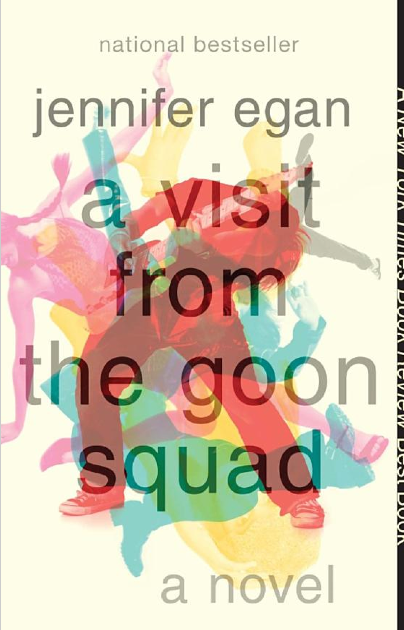
Brooklyn Bugle Book Club: “A Visit from the Goon Squad” and “The Invisible Circus” by Jennifer Egan

November 18, 2011

I admit to letting “A Visit from the Goon Squad” sit on my night table for several months after I bought it. “Look at Me” is a terrific book, but “The Keep” is less successful, though I admired Egan’s experiments with form. What I’d heard about “Goon Squad” was that some people loved it and some people hated it. There was no middle ground, it seemed.

Once I started it, I found “A Visit from the Goon Squad” to be a fascinating book with an expertly achieved structure. “Goon Squad” tells the story of Sasha, assistant to an aging record producer, Bennie, the record producer, and his friends. A few other people, like Bennie’s ex-wife, a publicist, and Sasha’s daughter Alison figure in it too. Told from shifting perspectives, sometimes in first person, sometimes in third, once in the second, every chapter layers what we’ve learned from earlier chapters, or colors that knowledge with depth and nuance. Sometimes the next chapter provides the adjacent narrative but other times it moves forward or back in time, or to another place entirely. One chapter is set in the future when school children are taught to write power points only. (Alison is able to convey plenty of meaning with her pauses.) The book is more complex to describe than to read, though reading it does take some concentration. It’s a good book for a plane or a convalescent (someone who’s in the second or third week after surgery).

When I finished it, I decided to read “The Invisible Circus,” Egan’s first novel, published in 1995. That book tells the story of 18-year-old Phoebe, who goes to Europe as soon as she is done with high school, hoping to find out the truth of her older sister Faith’s death. Unlike the subsequent novels, it’s a straightforward narrative, so accomplished it’s hard to believe it’s a first novel. It’s prescient, too—Egan describes the 1960s as “all about watching ourselves happen. . . This incredible feeling, standing outside, seeing the thing unfold. Like tripping. I remember thinking, Shit, this is going to be huge. Whatever it is.” It turned out to be is the publicly lived life, with social media Facebook and Twitter and Foursquare keeping everyone in the loop. (Though now that I have learned that Jennifer Egan dated Steve Jobs while she was in college, maybe she had a peek at the future. More about that next week, when I review Walter Isaacson’s biography of Jobs.)

What did you think of “A Visit From the Goon Squad”? Love it or hate it, or feel somewhere in between about it? Let us know in the comments.

Have a book you want me to know about? Email me at asbowie@gmail.com. I also blog about metrics.

From the Web

Books

Brooklyn Bugle Book Club: Courtney E. Smith Discusses Record Collecting for Girls

November 18, 2011


Author, music maven and former MTV programmer Courtney E. Smith discusses her book Record Collecting for Girls: Unleashing Your Inner Music Nerd, One Album at a Timein the premiere edition PacMan Sessions. Smith has enraged some feminists with her book while also garnering praise for encouraging young women to enjoy and embrace music beyond their comfort zone.

Find out why you should never date a Smiths fan and why musicians make lousy boyfriends to why Boz Scaggs should never be on anyone’s playlist all while the author tackles a game of PacMan.


From the Web

Books

Author Barron Lerner to be on “All Things Considered” today

November 17, 2011

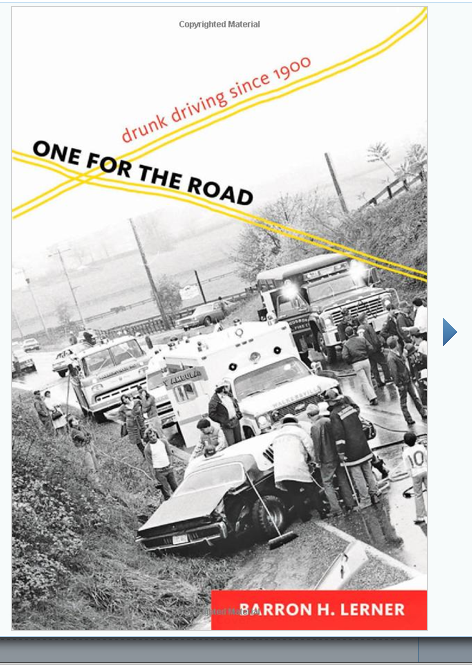
Barron Lerner, MD, author of “One for the Road: Drunk Driving Since 1900″ will be discussed the book on “All Things Considered” this afternoon. You can read my review of the book here. It’s a very thoughtful book, and you may listen to the interesting interview here.

From the Web

Books

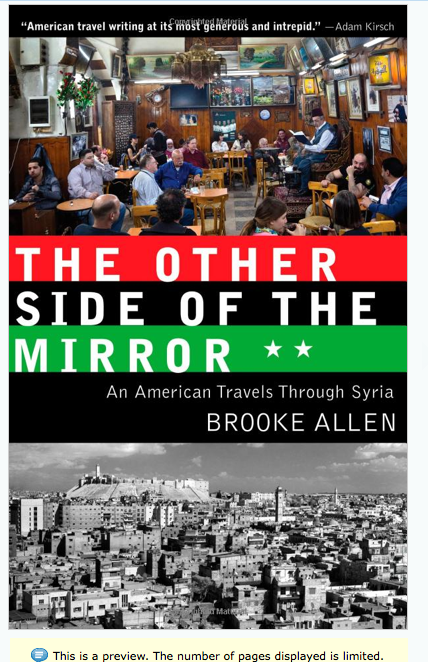
Brooklyn Bugle Book Club: “The Other Side of the Mirror: An American Travels Through Syria” by Brooke Allen

November 11, 2011

Brooke Allen closes her entertaining travelogue about two trips she took to Syria with a quote from Mark Twain: “Travel is fatal to prejudice, bigotry, and narrow-mindedness.” At a time when many Americans view Arab lands in the middle East as monolithic bastions of Sharia law that succor terrorists, she and her husband (who is Jewish) took their two teenaged daughters on a trip to see the sights of Syria. (Allen went back on a subsequent trip with two adult friends.) And as she describes it, Syria is worth the trip.

A crossroads of trade (the Silk Road harbors were in greater Syria) and religion (four major western faiths were followed here more or less from their beginnings), Syria was at the center of the ancient and medieval worlds. Damascus has been continuously inhabited for centuries, Allen reports. Other sites were built on, successively, by Jews, Romans, Crusaders, Byzantines, Ottomans. Tamerlane and Saladin built strongholds there. Some were destroyed by attacking Mongols. All of them left sights to see.

Allen divides her book into six overlapping sections that she uses to build an outline of Syria’s history and culture. “Leaders,” which briefly describes the Assads and their rule, comes last. Earlier, Allen describes the geopolitical reasons the Assads are in power. She notes also that “asad” means lion in Arabic; lions are a widespread decorative motif throughout Syria, giving the Assads obvious symbolic opportunities. Allen no more foresaw the Arabic Spring than did anyone else, and so her book does not address the unrest of 2011 (but see the excellent blog Syria Comment for up-to-date information).

The section “Ruins” opens and closes with hotel descriptions; there were some grand ones, and some grand visitors, including kings and queens as well as Patrick Leigh Fermor and T.E. Lawrence. There are ruins upon ruins, some still occupied, many still unearthed. And there is a long history of religious tolerance. Allen describes how archeologists have found, in one small area in Dura, pagan temples, temples to Palmyrene gods, a Christian house church (dating from the third century, it’s the oldest in Syria, from a time when Christianity was still an underground religion), and an ancient Jewish temple with painting after painting of Old Testament scenes, unique in Jewish history because of the proscription against graven images. A temple to Mithra, a Persian divinity, also emerged. Allen calls the juxtaposition characteristic of Syria, “[h]ere in this not-very-large community four religious systems existed simultaneously and apparently in harmony: the pagan, the Mithraic, the Judaic, and the Christian.”

Faith is by far the longest section: Syria was Jewish and Christian before the arrival of Islam, when it became a jumping off point for the Haj. The home also of many minor faiths and schismatic slivers of major ones, Syria remains a secular country today. Allen intersperses history, ancient and modern, including the sad history of the French mandate that arose once the victorious Western powers carved up the former Ottoman Empire after the end of the First World War. Syria’s location has meant many waves of refugees: Palestinians arrived in the wake of the Crusaders; Armenians came from Turkey after 1915; Iraqis have arrived in great numbers in the last decade. That description underlines one of Allen’s main points: religious syncretism in Syria has led to an open, diverse society (as long as its inhabitants are willing to leave politics to the few) that is welcoming to outsiders.

Now is probably not the best time to plan a trip to Syria, tempting though this book makes the prospect. In the meantime, the Met’s new Galleries for the Art of the Arab Lands, Turkey, Iran, Central Asia, and Later South Asia make a pretty good substitute. And then take a trip to Tanoreen in Bay Ridge for the food. Tell us your favorite local Middle Eastern restaurants and cultural centers in the comments.

Update, December 20: NYU’s Institute for the Study of the Ancient World, 15 E. 84th St, has an exhibit about Dura, “Edge of Empires: Pagans, Jews and Christians at Roman Dura-Europos” through January 8. The New York Times article about the exhibit is here.

Have a book you want me to know about? Email me at asbowie@gmail.com. I also blog about metrics at asbowie.blogspot.com.

From the Web

Books

Brooklyn Bugle Book Club: “Wendy and the Lost Boys: The Uncommon Life of Wendy Wasserstein” by Julie Salamon

November 4, 2011

Like it or not, Wendy Wasserstein, playwright and essayist who died at age 55 in 2006, was the voice of her generation, or at least that subset of it that was female and well educated. The 70s and early 80s were a confusing time to be a young woman. In those days before the well-reported decline of men, women fought to be given responsibilities and pay. Watching and eagerly joining in the rise of second stage feminism, hers was the generation that thought women could have it all—good educations, interesting jobs, strong relationships, and above all, children when they were ready for them. Ready in terms of  careers and personal development, that is.

Older men acknowledged their skills, paid them less than they paid the men, and tried to make up the difference with compliments. Younger men saw them as sisters, but the competitive kind, younger siblings threatening to skip into their grade. All of them laughed at the women, and that was hard to take: was it any wonder that the women’s movement got a reputation for not having a sense of humor? Wendy Wasserstein was the first major cultural figure to reflect the confusion in such a funny way. Her essays sparkled; watching “Uncommon Women and Others” was like listening to a late-night conversation with your college friends. She won the Pulitzer and a Tony; she was a celebrity in demand as a speaker; she was a mentor to young actors and playwrights.

Her life provided her material and Wasserstein, quoted by Salamon, said it best: “Funny is a complicated issue.” The life, as reported in this new biography, was messy and secretive. There were family secrets, including an institutionalized older brother (he was either developmentally disabled or mentally ill; Salamon conflates the two) whose existence was kept from Wendy for many years. Successful in many ways, Wasserstein never married, apparently an issue for her mother (her brother Bruce, on the other hand, married four times). Her many accomplishments never seemed to satisfy her demanding mother. At 48 she conceived a child, who was born prematurely. And Salamon reports that Wasserstein selectively kept and disclosed secrets in her chosen family of friends, former lovers, and unattainable but supportive gay men.

Salamon deconstructs the personality Wasserstein showed publicly in her essays and journalism, and identifies large gaps between the representation and the truth, but she never successfully puts the full picture together. Two sides of Wasserstein come through. Salamon regards the grown-up Wendy as a wild child, someone who needed looking after and who left behind something of a mess, unhappy friends and a very young daughter. But Salamon also reports that Wasserstein identified literary executors and made plans for her daughter. The impish giggling funny woman who could turn into a savvy negotiator for herself seems to be a reasonable development from the beginnings Salamon has identified. The selfish, guarded woman, quick to take offense at a perceived slight, comes out of nowhere. Salamon does not integrate them, and as a result this biography, while telling what should be a fascinating story, leaves an unfortunate hole at its center. And the book is not helped by the wooden writing or the lengthy excerpts from documents like a Mount Holyoke College memo about the broadcast of “Uncommon Women.” This is not the biography that Wendy Wasserstein deserves.

Have a  book you want me to know about? Email me at asbowie@gmail.com. I also blog about data issues.

From the Web

Life

Where’s Brooklyn’s Best Car Wash?

November 4, 2011

If you live in Brownstone Brooklyn, you have to be nuts to own a car.  But for our pals in Bensonhurst or Gerritsen Beach for example, you gotta have wheels.  But no matter where you live in the BK, having a nice clean car is one of the few affordable luxuries you can have these days.  So, where is Brooklyn’s best car wash? More importantly, is it the one owned by a former NBA star?

Over at Yelp, where everyone is an “expert” they’ve identified these as Brooklyn’s top 5:

Golden Touch Car Wash – Park Slope
296 4th Avenue
Reviews here seem legit and many claim of a magical $30 detailing package.

Auto Bath Hand Car Wash – Bath Beach
164 Bay 19 St
Comes in second, despite only 3 reviews with one from a dude who totally disses Golden Touch. Ah! Social media, you are so “reliable”.

Williamsburg Hand Wash and Detail Center – Williamsburg
646 Lorimer St
Lots of raves, but we’re always a little suspect of reviews that overtly shout out the owner or staff.

Manhattan Bridge Car Wash – Downtown Brooklyn
275 Flatbush Ave Ext
Red flag for two negative reviews that are so poorly written they have to be real… right?

Oakley’s Carwash – Brighton Beach
25 Neptune Ave
Former NY Knick Charles Oakley owns the place and sometimes he can be seen buffing cars.

Where do you get your car washed? Like it? Love it? Comment below!

From the Web

Arts and Entertainment

An Eclectic Mix at Steampunk 2011

November 1, 2011

Designers conjured up an eclectic array of fashions at the magic-themed Steampunk 2011 event held in the DUMBO Loft on October 23, which attracted a few hundred curious locals and long-time fans of the subculture and its imaginative aesthetic informed by Victorian styles and elements of science fiction and fantasy.

“I’m a science fiction fan from way back and steampunk is just another genre within the genre,” said Park Slope resident Presley Acuna. “This show was a lot of fun last year, so I was inspired to come again. In particular, the fashion part is really adventurous.”

Acuna and other intrigued onlookers crowded around the stage for the evening fashion show, which featured a diverse array of styles from four distinct designers. Kristin Costa and No Human Intentions presented elaborate fashions that embraced the steampunk aesthetic, while Alex London and Berít New York veered off into other genres with collections inspired by the Elizabethan era and the Middle Ages.

Alex_London_Dress

Alex London dress, Photo by Jessica Weiser

“I’m obsessed with the mystery around Queen Elizabeth I. She was so enigmatic, especially with the veils,” said London of the inspiration behind her Fall/Winter 2012 collection, “God Save the Queen” that was previewed at the show. Veils added a dramatic touch to her stunning pieces, which included full-length gowns and knee-length dresses made from extravagant fabrics such as brocade, jacquard, silk tulle, chantilly lace and velvet in regal hues of gold offset by somber shades of black. Fitted bodices and tailored jackets balanced the full skirts trimmed with lace and tulle, while the veils and dark feathered accessories added a macabre edge. Duality is at the heart of this collection that will be shown in full at New York Fashion Week. “I’ve always loved that with most women, and especially Queen Elizabeth, there is such a deep fragility that comes with the nature of being raised female,” London explained. “They’re so fragile, but they can just completely tear you apart because they’re also so vicious and powerful. It’s an interesting duality.”

Berit New York Fairy Warrior Collection

Fashions from Berít New York, Photo by Knightmare6 Photography

While London’s styles evoked the Elizabethan era, Berít New York explored the Middle Ages with core pieces for men and women from the Autumn/Winter 2011 collection, “Fairy Warriors.” Streamlined capes and tunics in contrasting tones of burgundy and fawn were paired with sleek black leggings and brown vinyl spats resembling leather leg armor. “I wanted it to be very luxurious,” said Brit Frady-Williams, the designer behind the Berít New York label. She used velvet and micro-suede to bring a sumptuous vibe to the collection, which was influenced by medieval times and fantasy fiction. “I always take a historical influence and mix it with sci-fi or fantasy elements, so there is that blend of themes and styles,” explained Frady-Williams, who drew inspiration from the costumes featured in the TV series “Legend of the Seeker” and movie trilogy “The Lord of the Rings.” In addition to the styles from the “Fairy Warriors” collection, Frady-Williams showed some steampunk-inspired pieces like layered skirts and corsets that were created specifically for the event.

“It really was a mix,” the Frady-Williams noted about the range of styles that she and the other designers presented. As the fashion show organizer, Frady-Williams did not dictate that the collections stay strictly within the confines of the steampunk aesthetic. “I didn’t limit the designers,” Frady-Williams explained. “This show was meant to be artsy and thematic.”

Variations on the steampunk theme could also be found at the event’s small market area, where the focus was primarily on jewelry and accessories.

Once_Lost_Jewelry

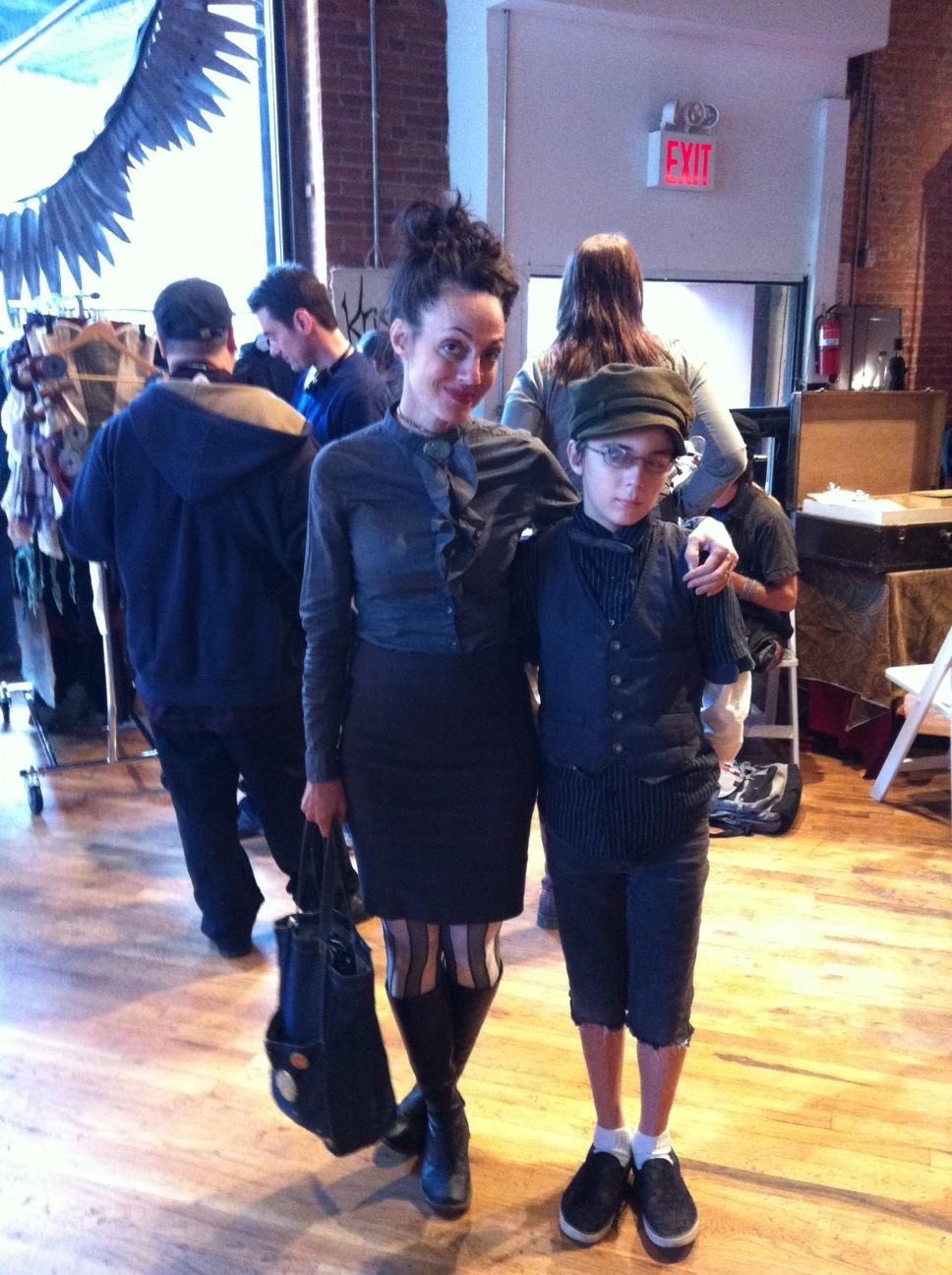
Designer Michelle Harris (left) with sister Janelle LaCoille, Photo by Kathy Malone

At the booth for Once Lost Jewelry, designer Michelle Harris showed off striking pieces made from repurposed antique jewelry and watches. Her signature pieces on display included enchanting pendants made of antique watch cases with shimmering bits of peacock feathers or butterfly wings in place of inner workings. “I’ll go out and hunt for things at antique shops and estate sales and I won’t put a piece together until I find that all the elements mesh really well, so sometimes it takes me a few years to get something perfect,” said the third-generation jeweler, who learned how to cast gold at an early age. Having produced her designs professionally for nearly 12 years, Harris was not even aware of the steampunk genre until about five years ago. “People started coming up to me and saying my stuff was steampunk, so I had to research it,” explained the designer, who started vending at steampunk shows soon after.

La_China_Loca

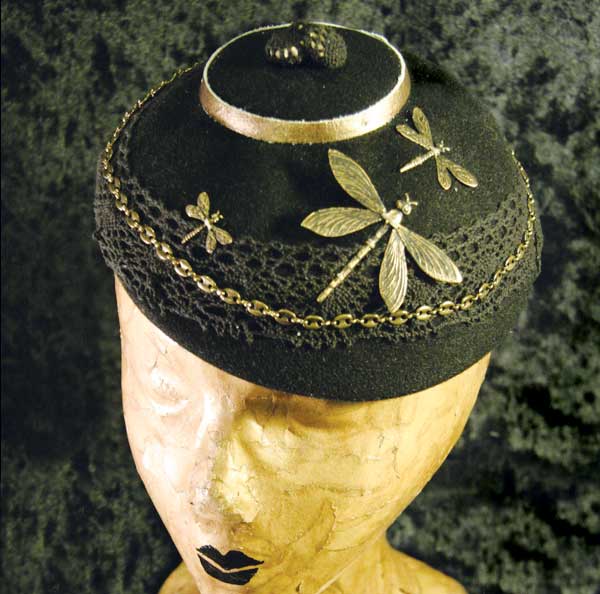
La China Loca headwear, Photo by Anastasia Andino

While Harris arrived organically at the steampunk aesthetic, headwear designer Anastasia Andino of La China Loca made a conscious decision to explore the genre after participating in the Steampunk 2010 event held one year ago at the DUMBO Loft. “I actually made a whole line in and around the steampunk aesthetic inspired by last year’s event,” Andino explained. “It was an opportunity to do more interesting, creative and fun pieces that I don’t normally do,” said the designer, who incorporated ruffles, metal bugs, pinwheels and cranks into the specialty line. The steampunk aesthetic has continued to influence Andino’s creations, although she has modified it somewhat to suit the clean lines characteristic of her brand. “I make it my own,” said the designer, whose sleek wool hats on display were punched up by feathers and metal adornments such as dragonflies and spirals.

Lori_Boone

Lori Nelson(left) with son Boone Campbell, Photo by Kathy Malone

While longtime steampunk fan Acuna was disappointed that there were no ray guns in the mix, event attendees like Park Slope resident Lori Nelson were pleased with the selection. “I like this event because I feel like it is unique, but at the same time, accessible,” Nelson said.

“It’s an event for everybody. You can just be an onlooker and be curious and walk in to see what is going on,” explained Frady-Williams, who has produced annual steampunk happenings for the past four years with organizer Kathy Malone, owner of Clementine Events and founder of the now-defunct Brooklyn Indie Market.

The Steampunk 2011 event also featured a sideshow act by magician Nelson Lugo, a musical performance by Psyche Corporation and a photography booth by Tsirkus Fotografika. The lineup of vendors included 19 Moons, Absynthe Jewelry, Ami Nyitray Designs, Barker’s Herbs & Heirlooms, Dark Side Customs, Izile’s Oddities, Mechanique, Nemesis Jewelry, Sultana Maria Jewelry and The Sideshow Soap Co.

From the Web