
Monthly Archives

January 2012

Books

Brooklyn Bugle Book Club: “In the Garden of Beasts” by Erik Larson

January 27, 2012

Hitler rose to power in Germany in 1933. In that same year, Franklin D. Roosevelt was inaugurated as President of the United States, and in due course he appointed a new United States Ambassador to Germany. After several false starts—it was clearly going to be a difficult post, given the world financial turmoil and German political upheaval—the position went to William Dodd, a chairman of the Department of History at the University of Chicago and biographer (and friend) of Woodrow Wilson. Using diaries and letters, Erik Larson relates the experiences of Dodd and his family, primarily his daughter, Martha, during Dodd’s 1933-1937 tenure.

Those were tumultuous years indeed in Germany. Once in power, the Nazis reneged on the Versailles Treaty’s onerous war repayment provisions; rebuilt the country’s armed forces; and passed laws limiting and ultimately denying citizenship rights of Jewish citizens. The Night of the Long Knives occurred during the Dodds’ stay in Germany, and that’s essentially where the story ends. Larson makes no bones about what he is doing. In his introduction, he says, “I made no effort in these pages to write another grand history of the age.” Instead, he tells of drives in the country and dinner parties, diplomatic receptions and Nazi Party rallies.

Although both Dodd children (they were already adults in their 20s) moved to Germany with their parents, Larson focuses on William Dodd, the ambassador, and his daughter, Martha. I suspect this is because both of them left substantial amounts of documentary material, unlike the mother and son. (Confusingly, both children were named after their parents. Larson refers to the son, who barely appears in the book, as Billy, and the mother, who is mostly a cipher, though one with an evident backbone, as Mattie.) At first the family was enchanted with the evident prosperity and lovely countryside of Germany. As time passed, evidence of Nazi brutality became impossible to ignore; early in their stay, the two Dodd children witnessed the thuggish humiliation of a German woman engaged to a Jew.

Dodd was one of the few US diplomats to urge that the world engage, rather than ignore or appease, Hitler. Unlike most other members of the diplomatic service at the time, he was not independently wealthy, and he tried to live within his salary as US Ambassador. These acts did nothing to endear him to his superiors at home, or to his staff at the embassy. At the same time, both his children flirted with Soviet communism, and Martha had a long affair with an NKVD operative. Both children’s lives were dominated, in the end, by their actions in Germany during these years. Martha and her husband later fled the US rather than testify before the House Un-American Activities Committee. Billy’s activities had also drawn the attention of HUAC; in the 1940s he was declared “unfit” for employment by the federal government, when he was working for the Federal Communications Committee.

This is a difficult story, which Larson tells well, as far as he goes. Larson spends 90% of the book on the Dodds’ first year in Berlin, finishing up the next three and a half years in a handful of pages. It’s not clear whether he petered out or his sources did. But that first year of Nazi power comes alive in vivid and often grotesque detail. It makes for an entertaining read, but will leave the enquiring reader curious to know more. Do you agree? Let us know in the comments.

Have a book you want me to know about? Email me at asbowie@gmail.com. I also blog about metrics here.

From the Web

Events

Transit Museum Introduces New Discussion Series “Problem Solvers” with guest Sarah Kaufman

January 23, 2012

The New York Transit Museum has announced the start of an informal discussion series, Problem Solvers, hosted by Ben Kabak, founder of the blog Second Avenue Sagas. The free series begins on Wednesday, February 1 at 6:30 pm and will take an intimate look at the most interesting people working behind-the-scenes to operate the city’s century-old transit system.

Mr. Kabak’s first guest is Sarah Kaufman, who led the Metropolitan Transportation Authority’s open data program. As an innovative and pragmatic leader within the MTA, Ms. Kaufman worked to put the agency on the fast track to the digital age, collaborating with third-party software developers to improve public access to transit data. Ms. Kaufman recently joined NYU Wagner’s Rudin Center for Transportation Policy and Management. The hour-long program includes audience Q & A.

Problem Solvers continues on April 25th when Mr. Kabak, dubbed “The Transit Authority” by the Village Voice, will engage a second interviewee in informal conversation at the Transit Museum.

Doors open at 6 pm; program begins at 6:30. Guests are invited to explore the Museum prior to the start of the program. Light refreshments will be served.

What: Free! Problem Solvers discussion series debut

Who: Host Ben Kabak (Second Ave. Sagas) with guest Sarah Kaufman

When: Wednesday, February 1, 6:30 pm (doors open at 6 pm)

Where: New York Transit Museum, inside the subway station at the corner of Boerum Place and Schermerhorn Street, Brooklyn. General information (718) 694-1600 or click on this link.

From the Web

Books

Brooklyn Bugle Book Club: “The Thorn and the Blossom” by Theodora Goss

January 20, 2012

Brendan and Evelyn meet as young students. Evelyn, an American studying at Oxford, is taking a week’s vacation in Cornwall before she heads home. Brendan is also at Oxford, but lets Evelyn think he is merely a local. The two, both misfits in their own families, start to fall in love after spending the better part of a week together. Their love of a Cornish myth (a local Gawain and the Green Knight predecessor) unites them, yet each keeps a secret, and soon they go their separate ways. They meet again many years later. Oh, and they might possibly be the reincarnated version of the lovers in the myth.

This romance is published as an accordion book, with Brendan’s story told at one end, and, when you turn the book around, Evelyn’s from the other. An accordion book telling a story from two characters’ points of view poses a conundrum for the reader: whose side to read first? After reading the first side, the reader has to wonder: will reading the other side resolve the mysteries or even add anything to the story? This slight book by Theodora Goss succeeds in the first but I must admit I did not find the story so interesting that I was excited about reading it again. A gap of a few days made a difference.

Accordion books are more common in other cultures (here’s a Burmese astrology handbook) and I was at first concerned that the binding was a gimmick intended to cover a weak structure. The story works, and there’s a nice parallel to the Cornish myth, with a love triangle that reverberates down the centuries. This is a very short book, less than 100 pages for both characters, so don’t plan for it to take you through an airplane trip. It is beautifully illustrated by Scott McKowen and comes in a beautiful, uncluttered box.

Have a book you want me to know about? Email me at asbowie@gmail.com. And check out my metrics blog.

From the Web

Events

Transit Museum Plans Day for Special Needs Kids January 22

January 17, 2012

The New York Transit Museum and Extreme Kids & Crew invite families with children who have special needs to visit the Transit Museum on Sunday, January 22 for a Special Day for Special Kids. Families with special needs kids receive free admission to the Museum between 10 am and 11 am, with a 50% discount thereafter when the Museum opens to the general public.

A variety of transit-themed activities are scheduled throughout the day including an art project using old metrocards, a scavenger hunt on the Museum’s platform level and a musical performance by the Brooklyn-based M Shanghai String Band. In addition, a “Quiet Room” for special needs families will be available from 10 am to 2 pm as a place to take a break from the excitement.

The Transit Museum offers a number of programs for special needs children, including guided programs for school and camp groups, travel training to learn independent travel on the subways, and the Subway Sleuths Afterschool Program where children on the autism spectrum practice social skills while working together on projects about subway history. Extreme Kids & Crew is a parent-run, non-profit organization that provides a safe sensory space where Brooklyn’s kids with disabilities and their families can gather to play, teach, learn, sing, sprawl and be.

The New York Transit Museum is located at the corner of Boerum Place & Schermerhorn Streets in Brooklyn. For general information, call  (718) 694-1600  or visit the website.


From the Web

Books

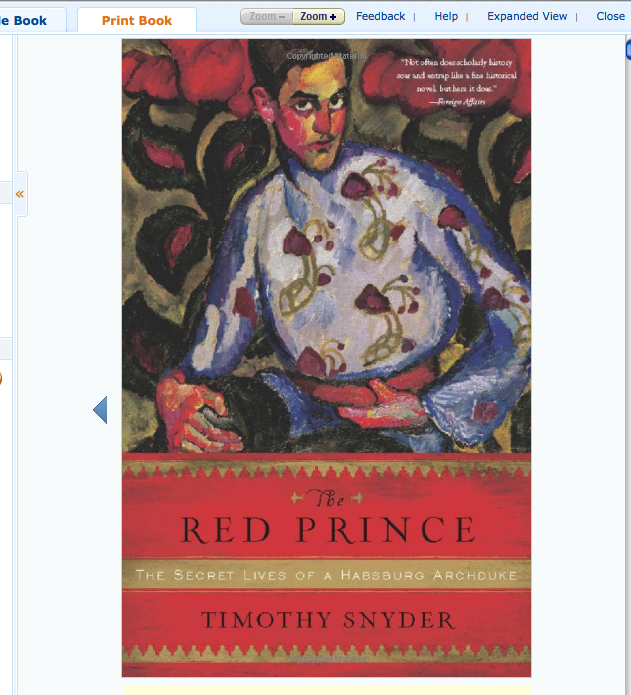
Brooklyn Bugle Book Club: “The Red Prince: The Secret Lives of a Habsburg Archduke” by Timothy Snyder

January 13, 2012

Before they became independent countries in the 20th century, Austria, the Czech Republic, Slovakia, Hungary, Bosnia-Herzegovina, and parts of Poland and Ukraine were territories, or provinces, or sometimes principalities, of the Habsburg empire. The Habsburg family was large and connected, all the more so because cousins often married. (A Habsburg sits on the throne of Spain today.) Habsburg Archdukes governed the various provinces under the Emperor. This book tells the story of one scion of the branch that governed Poland, or tried to. Wilhelm, born in 1895, rejected his father’s efforts to make him and his siblings Polish, and threw his lot in with the Ukrainians.

This was not a simple thing to do, given the complexities of 20th century central-European politics. It was a Habsburg Archduke who was assassinated in Sarajevo in 1914. Wilhelm served in the Habsburg army during that war, then became involved in Ukrainian politics, hoping to become king of an independent Ukraine. The war ended the Habsburg empire, and Wilhelm spent the interwar years in France, until he was forced to leave after a scandal, and then Austria. He flirted with fascism, and ultimately took up the cause of Ukrainian nationalism once again. After the war, once the Soviets moved in, he was arrested in Vienna and died in Soviet custody.

Snyder traces the development and clashes of nationalism, imperial ambition, religion and ethnicity, showing how they played out in Europe through the century. He makes a confusing and complex history extremely clear. Snyder suggests it is not far-fetched to think of modern Europe as fulfilling Habsburg ideas. Indeed, Otto von Habsburg, whose father was the last Habsburg emperor, was a member of the European Parliament for 20 years. He died in 2011, at the age of 98. The Central and Eastern European history before World War II was something of a blank for me, and this book does an admirable job of filling it in. Snyder’s most recent book is called “Bloodlands: Europe Between Hitler and Stalin.”

Have a book you want me to know about? Email me at asbowie@gmail.com. I also blog here about metrics.

From the Web

Books

Downton Abbey and Books

January 12, 2012

As someone who grew up reading classics after watching the Masterpiece Theatre versions (“Cousin Bette,” in particular, got me started on Balzac) I was very taken by today’s article in the New York Times about publishers efforts to tie new releases into the series. Naturally, I was looking for my own favorite World War I novels. The best one not listed is “Birdsong” by Sebastian Faulks, about a British soldier’s affair with a French woman but highly memorable for its description of a sapper‘s life in the trenches.

What’s your favorite? Let us know in the comments. Have a book you want me to know about? Email me at asbowie@gmail.com. I also blog about metrics at asbowie.blogspot.com.

From the Web