Monthly Archives

February 2012

Books

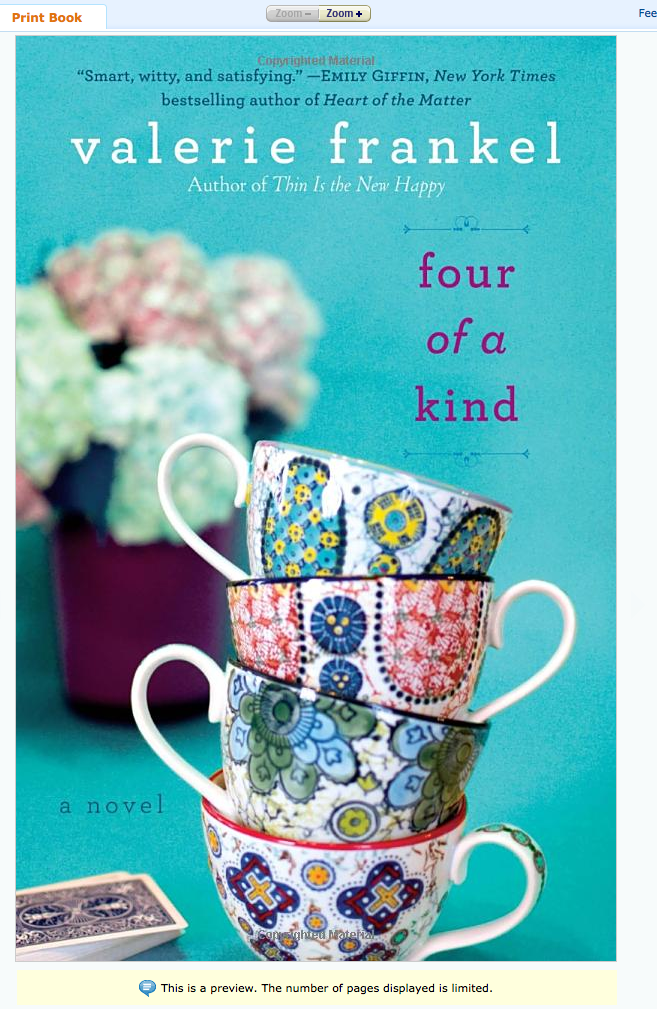
Brooklyn Bugle Book Club: “Four of a Kind” by Valerie Frankel

February 24, 2012

As Valerie Frankel’s new novel, set in and around a private school in Brooklyn Heights opens, Bess, mother of four and president of the school’s Parent Association, has invited Robin, a single mother, Carol, an African-American physician, and Alicia, who is Caucasian and lives above Fairway in Red Hook, to her beautifully decorated Clinton Street town house to discuss forming a Diversity Committee for the school. Although each has a child in the fourth grade, the women barely know each other, and each wonders why she was included. (Well, to Carla it’s annoyingly obvious.) Unable to find their way into the subject at hand, the women find themselves playing a form of strip poker, giving up secrets instead of clothes.

It’s a clever setup for a novel about women’s relationships. After their awkward initial meeting, the women continue to meet monthly. They continue to play– their favorite game is Texas hold-em — and we meet their husbands and children, see them at work and at home, and come to learn how each of them has ended up in Brooklyn. The kids all get to know each other better, as childcare issues (and who doesn’t have those?) mean the children are sometimes brought along, with 16-year-old Amy, Bess’ oldest child, as sitter.

As they play, the women challenge each other to be their best selves. They will all need the support, as each faces a crisis during the year. Amy angrily edges away from Bess. Alicia’s son struggles in school and her husband is out of work, adding stress to a tense marriage. Carol’s husband loses his job, and she is offered an unhappy option at work. And Robin, the single mom? She decides to try to find again the man she has long thought of as her sperm donor, with whom she had a one-night stand 11 years earlier. Sure enough, he wants to have a role in his daughter’s life.

Frankel uses her Brooklyn Heights setting well, making use of recognizable landmarks, restaurants, and of course the Promenade. The characters travel, to work, in Manhattan or Cobble Hill, to Red Hook, to Clinton Hill, and even, for one memorable and out-of-character weekend, to Atlantic City. The women’s jobs, particularly Alicia’s in a boutique advertising agency and Carol’s in the Long Island College Hospital pediatrics clinic, are convincingly described. If I have one quibble, it’s that it seems unlikely that a woman of Robin’s education and intelligence would be satisfied doing piecework for Zogby polls for a living.

Over the course of the year, not much Diversity Committee business gets done, but a lot of interesting events occur as the women struggle to support each other in the face of the challenges each faces. Each learns to rely on some facet of one of the others that she hadn’t first thought was important. “Four of a Kind” is a very entertaining and entirely believable story of four women who form a fast friendship.

Have a book you want me to know about? Email me at asbowie@gmail.com. I also have a blog about numbers for people who hate numbers.
From the Web

Food

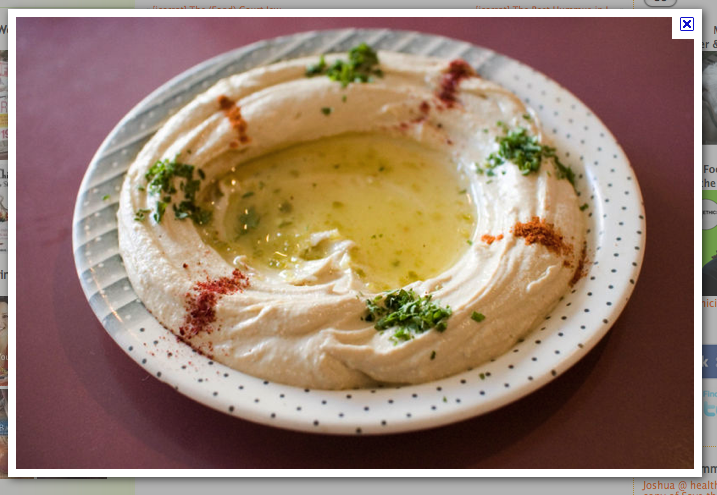
Homemade hummus in Brooklyn

February 20, 2012

On various trips to the Middle East my family has debated the merits of hummus in all its glorious presentations and tastes. Sometimes it’s topped with zattar, other times with greens or a sprinkling of whole chickpeas. But the main dividing line always comes down to tahini: do you include a lot, or a little?

Even at home, we eat a lot of hummus. But after reading this article in Slate, I knew I had to stop buying it. How hard could it be to make hummus? I started to do some research. Turns out there are a lot of opinions about hummus, and people don’t just argue over how much tahini to use. Canned chickpeas or fresh? Paprika or cumin? Tahini or . . . . peanut butter? Really?

I considered my favorite recipe sites: allrecipes.com, mideastfood.com, Ina Garten on the Food Network. But I ended up going with a recipe I found on the Hummus Blog, an easygoing (if opinionated) blog with the slogan “Give chickpeas a chance . . .” If you are using dried chickpeas ($2.49 a pound at Fairway for organic chickpeas) the recipe includes a lot of cranky details, like suggestions to change the cooking water midway through the cooking. As with many legumes, you need to soak and rinse dried chickpeas to get rid of undigestible sugars.

But it’s worth using dried chickpeas – they taste delicious. Eventually. I soaked my chickpeas overnight, then changed the water and soaked them some more. I cooked them for an hour and a half in fresh water with baking soda (I forgot to add it when I soaked them overnight). And then I went out to buy tahini.

“This one’s the best!” the man at Damascus Bakery (195 Atlantic Avenue) told me cheerily, handing me a jar of Al Wadi tahini from Lebanon ($4.75 for a pound, shake the jar before you use the tahini). He rolled his eyes when I told him what I was making. I used Celtic sea salt I bought at the Brooklyn Foodshed (sorry, it was a couple of months ago, I forget how much it cost). I stirred in about two tablespoons of tahini (we are of the less tahini is better school). And I didn’t have a lemon, but I did have half a lime, so I used that. I added garlic and cumin. And after a couple of practice runs, I learned two useful lessons. Put the garlic in the food processor with the cooked chickpeas, so it’s evenly distributed. And add quite a lot of the cooking water, counterintuitive though that seems. The chickpeas soak it right up.

We topped it with za’atar (available at Damascus Bakery, or you can make your own) and olive oil. The bottom line? It’s delicious.

Picture source: jcarrot.org

Update March 1: Before I posted originally I did some inconclusive research on the baking soda issue, which is why I didn’t address it. According to both The Hummus Blog and a food scientist, it helps to soften the chickpeas to the right consistency. For more of the science behind hummus, like whether it’s worth waiting for the cooked chickpeas to cool before you mash them (it is!) see this article.

From the Web

Books, Events, History

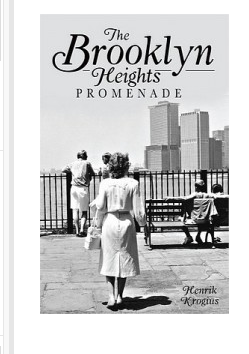
Brooklyn Bugle Book Club: “The Brooklyn Heights Promenade” by Henrik Krogius

February 17, 2012

Brooklyn Heights residents are justly proud of our Promenade overlooking New York Harbor. Cantilevered over the Brooklyn-Queens Expressway, it offers stunning views of the harbor, the Statue of Liberty, and Brooklyn and Manhattan Bridges, the Manhattan skyline, and Brooklyn Bridge Park. But the origins of the Promenade are somewhat murky, and Henrik Krogius has devoted a great deal of time over the years to interviewing participants and reviewing articles, meeting notes, and hearing transcripts. He brings his efforts together in this slim book, which synthesizes years of research and reprints a selection of articles from the Brooklyn Heights Press and Cobble Hill News dating back to 1976. The book is illustrated with dozens of photographs, documenting the construction of the BQE, the cityscape before the road existed, and the Promenade.

Many people had a hand in the development of the highway, but surprisingly few of them were willing to claim credit for the Promenade. The road was originally intended to be built at one level, like most highways, and to cut through Brooklyn Heights. Robert Moses gets the blame for that proposal, which the Brooklyn Heights Association fought; eventually, the Furman Street route was settled on. The idea of a double decker highway was in the air for quite a while, as the Furman Street route cut through the back gardens of the houses on Columbia Heights.

Krogius describes the development and construction of the cantilevers, and discusses the shape of the supports and their additional function of reflecting sound away from the docs on Furman Street. He eventually concludes about the highway:

Ernest J. Clark, the project’s chief engineer, insisted that the design had been arrived at through trial and error by the team’s collaborative effort. Different ways of supporting the roadoways had been considered and their stresses and looks tested. As Clark recounted it, the cantilever design had evolved.

Krogius uncovers plenty of interesting information along the way. One example: the Promenade was ready and opened before the highway. It’s hard to imagine events happening in that order now. Curiously, no one claims credit for the idea of the Promenade, although there are several candidates, including the owners of the back gardens, and even, though he denied it, Robert Moses. Perhaps that is because, like the idea for the cantilevered highway itself, the Promenade was a good idea that also evolved. As Steven Johnson describes it in his book “Where Good Ideas Come From” some of the conditions needed for creativity are dense networks of people creating and overlapping, exposure to ideas and sharing of information, and the time that ideas or hunches need to mature. All of these factors were present in the years of planning and building the Promenade and the BQE, and the idea developed from a lot of suggestions until it was right there, seemingly obvious, to everyone. The Promenade belongs to all of us, and it is a nice thought that its origin belongs, in some sense, to the residents who preceded us.

Henrik Krogius will be speaking about his book at 6:00 pm on Thursday, March 1, at the Brooklyn  Women’s Exchange, 55 Pierrepont Street. The event is free.

Have a book you want me to know about? Email me at asbowie@gmail.com. I also blog about metrics here, and have a post about Mr. Johnson’s book here.

From the Web

Books

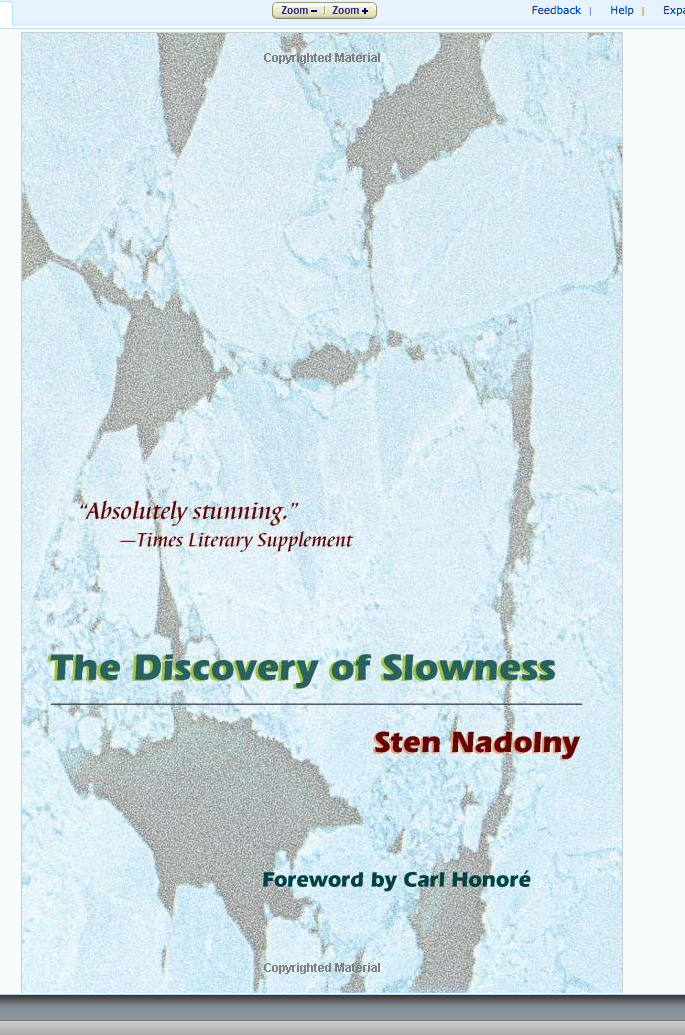
Brooklyn Bugle Book Club: “The Discovery of Slowness” by Sten Nadolny

February 10, 2012

Constant connection and instant communication have embedded speed in our lives. Sten Nadolny’s wonderful novel, “The Discovery of Slowness,” translated by Ralph Freedman, celebrates the opposite: the value of taking one’s time, of stopping to think before you act or speak.

“The Discovery of Slowness,” a historical novel, tells the story of John Franklin, a 19th century Englishman who arose from humble beginnings to become an Arctic explorer and the author of two best-sellers about his trips. Reviled and bullied as a child, John also paid close attention, perfecting an ability to stand or sit still for long hours. He used those hours for thinking things through, trying to understand the perspective of others. (I had to wonder whether he would be treated as autistic, or perhaps Aspergian, if he had lived more recently.) A sympathetic schoolmaster helped him achieve his dream of joining the Navy. As Nadolny tells it, eventually Franklin rose to the rank of captain, survived a first trip to the Arctic, and became governor of the penal colony Van Dieman’s Land. He died, of a stroke, during a return trip to the Arctic.

Nadolny puts the reader inside his character’s brain for much of the novel, and Franklin puts his unusual characteristics to good use. He learned to plan for the unforeseen, and his skill at putting himself in the place of others helped when he was negotiating with Inuits during his Arctic trips. His ability to anticipate orders was uncanny, and saved his ships from rash decisions by more senior officers on several occasions. Nadolny describes his thought process, and the impatience of those around him, in exquisite, tension-inducing detail. Here’s a moment when a party is disoriented in the Arctic:

John ordered the men to build an emergency shelter out of ice plates. Reid made no bones of the fact that he would have preferred to go on simply at a right angle to where they had been walking.

“We’ll stay warm that way, and we’ve got to arrive somewhere.”

“I take my time before I make mistakes,” Franklin countered amiably. He ordered them all to wrap themselves up as warmly as possible and sit around the oil lamp. The muskets were carefully loaded in case a polar bear might drop by.

John crouched and reflected. Whatever the other put forward–proposals, theories, questions–he only nodded and thought some more.

. . . But John still wasn’t ready. There was no reason to end his reflections prematurely, even if death was at the door. Finally he got up. . . . “fire a musket every three minutes, thirty times all told. After that, fire every ten minutes for three hours; after that, once an hour for two days. Please repeat.”

“Won’t we be dead by then, sir?”

“Possibly. But until then we fire. Please confirm.” . . . Just as nobody counted any more on getting an explanation, John said: “The entire ice field is turning around. It’s the only solution . . . “ Four hours later they heard a faint shot in the fog, and then again and again answers to their own shots . . .

This Franklin developed into a gifted leader of men, particularly during the ravages of an Arctic winter. He was also a humane governor of Van Dieman’s Land, ensuring that what was a hierarchical penal colony could begin to transform itself into the Australian state of Tasmania. This is a book that amply repays the reader who takes the time to read, think about, and absorb it.

Have a book you want me to know about? Email me at asbowie@gmail.com. I also blog about metrics here.

From the Web

Books

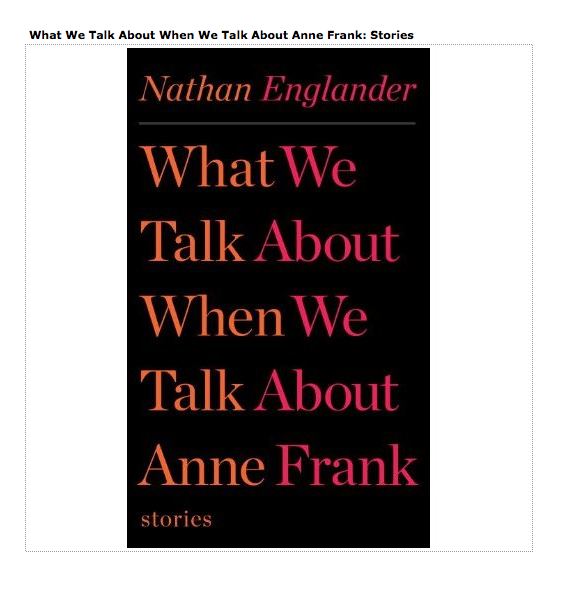
Brooklyn Bugle Book Club: “What We Talk About When We Talk About Anne Frank” by Nathan Englander

February 7, 2012

For many Jews, the world is and remains a fragile place. Israel is surrounded by enemies, many of whom have vowed her destruction. Intermarriage and secular life have diminished traditional Jewish culture. The Holocaust survivors are dying of old age, and the sense of righteousness their story conveys is in danger of dying with them. The growth of Arab and Haredi populations threatens what many Jews – American and Israeli – think of as Israel’s identity as a modern, secular state.

This uncertainty raises many questions for Nathan Englander, such as: might it ever acceptable for Holocaust survivors to use vigilante justice? Have Jews learned to organize resistance when they need to? What does Jewish guilt mean in a place where a peep show costs $1? What does society owe someone who lost his entire family, and then had to fight to survive? Englander uses the stories in his accomplished new collection “What We Talk About When We Talk About Anne Frank,” to illuminate these questions and possible answers to them.

In “Sister Hills” two families settle in the austere but beautiful part of the West Bank known during biblical times as Samaria. In the story, the army takes a father, then a son, then another. Settlers take land. A mother takes a daughter. What happens when we make promises we have no intention of keeping? Englander’s answer is a lot of unintended consequences: a family is torn apart, an ancient olive tree is harmed, a country lives with a deeply resentful minority. In its symmetry “Sister Hills” is a near inversion of “The Gift of the Magi,” except that instead of giving, its characters take.

In the title story, recently published also in The New Yorker, two couples, one secular and living in the United States, one Chasidic and living in Israel, reunite in the secular couple’s Florida home. A stilted reunion becomes a jovial discussion ranging from how to manage life with a house full of daughters (Israelis) or one son (the Americans). The couples get high together, and run outside into a Florida rainstorm. Most crucially, the couples play what they call the Anne Frank game, the Righteous Gentile game: who will hide us if the need arises? And before they know it, the day has veered into dangerous marital territory. We read what we need to into the Frank family’s story because, just as we do when we talk about love, what we talk about when we talk about Anne Frank is love, and trust, and life itself.

The other stories in the collection, published today, are similarly thought-provoking. Do you agree? Let us know in the comments.

Have a book you want me to know about? Email me at asbowie@gmail.com. I also blog about metrics  – for people who hate numbers – here.

From the Web

Events

Missed Connections at NY Transit Museum on Valentine’s Day

February 3, 2012

Find your Missed Connection at the NY Transit Museum on Valentine’s Day!

*Free admission to Love-in-Transit Party for all would-be romantics
*NY Times Metro writer Alan Feuer reads poems based on Craigslist Missed Connections posts
*Artist Sophie Blackall has a slideshow and will sign copies of her book Missed Connections: Love, Lost and Found
*Snap a photo in the token booth
*Food (Brooklyn Brewery) and Music (You Bred Raptors?)

Where: NY Transit Museum, Boerum Place and Schermerhorn Street, Brooklyn Heights

When: Tuesday, February 14, 6-8 pm

From the Web

Books

Brooklyn Bugle Book Club: “The Stranger’s Child” by Alan Hollinghurst

February 3, 2012

Every once in a while I read a book that is so good I cannot bear to put it down, but at the same time I cannot bear to finish it because then it will be done and I will never be in suspense again. “The Stranger’s Child,” a new book by Alan Hollinghurst, is one of these books.

The book tells the story, in five parts spanning nearly a century, of two families, the Sawles and the Valances, and two houses, the Sawles’ suburban home Two Acres, and the aristocratic Valances’ country pile Corley Court. Cecil Valance visits the Sawles at Two Acres, where two of the family’s three children, Daphne and George, have fallen in love with him. He writes a poem in Daphne’s autograph book; the poem, a paean to rural England, long outlives him, as Cecil is killed in the Great War. Each of the book’s parts centers around a love affair, or several, and the four later parts consider mysteries spawned in the first.

The book is a comedy of manners, with many telling details—a character is put down because he attended a red brick university; a memoir with a hand-written dedication is discovered 30 years later in a second-hand bookstore; a Victorian trophy house becomes a later generation’s hideous pile, broken up into rooms to let, its gardens subdivided for tract houses. Characters peer out from the closet, sometimes but not always retreating into it and firmly slamming the door. A minor event, glancingly mentioned in a letter or memoir, is interpreted as the key to a character by a later generation.

The two houses keep reappearing. So does the shade of Cecil Valance, which wreathes through the lives of all the other characters. Paul Bryant, introduced in the third part, becomes Cecil’s unlikely literary biographer. But in writing about Cecil, Paul upends all the family myths and threatens to unearth family secrets. Paul forgets that his subjects are people, not characters, so he gets everything all wrong–or does he?

“The Stranger’s Child” is exquisite, complex without being cumbersome. The Sawle and Valance families grow together into a large vine, the roots deep and the leaves blurring the outlines of the structure beneath. The younger characters try to untangle the history, while the elders prefer to keep their histories to themselves. Everyone’s efforts give the book its charm, and whether anyone succeeds gives the story its suspense. The book leaves a lot up to the reader, which is part of its appeal. Let us know your interpretation in the comments.

Have a book you want me to know about? Email me at asbowie@gmail.com. I also blog about metrics here.

From the Web