Monthly Archives

April 2012

Books

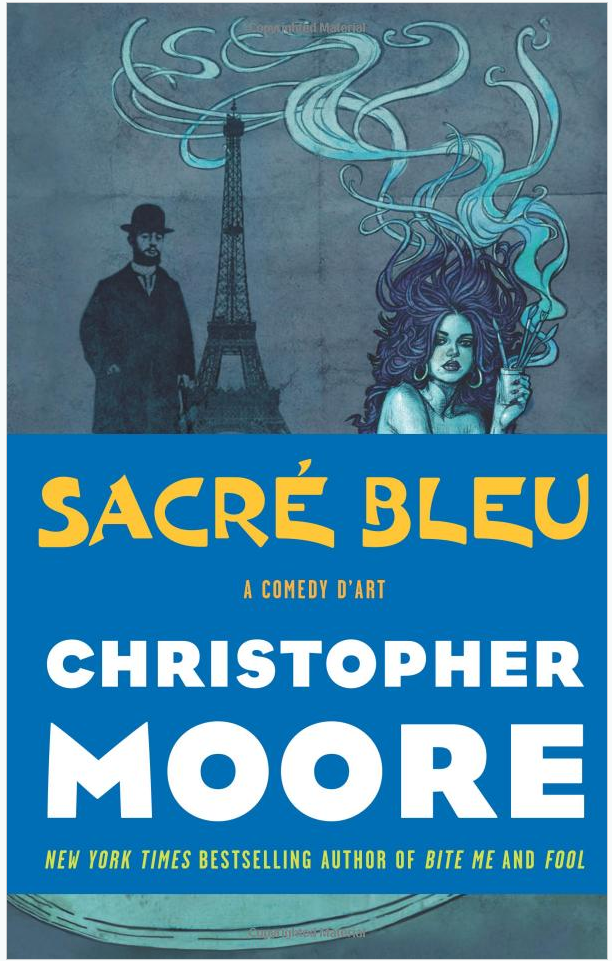
Brooklyn Bugle Book Club: “Sacre Bleu” by Christopher Moore

April 27, 2012

Cover photo via Amazon.com

In Paris, in the second half of the 19th century, the painters Henri de Toulouse-Lautrec, Pierre-Auguste Renoir, Henri Seurat, Paul Gauguin, Claude Monet, Camille Pissarro, the art dealer Theo van Gogh, and assorted others, among them the fictional baker and painter Lucien Lessard, try to track down someone they call the Colorman, who they fear might be responsible for the death of Vincent van Gogh. (Set aside the fact that you know that Vincent van Gogh committed suicide – this is fiction, you are suspending disbelief for the moment.) In their search, the painters visit cafes, nightclubs, prostitutes, the Lessards’ bakery, and a father and son known as Les Professeurs Bastard. The action moves back and forth between Paris, Arles, and a few other spots where painters may have congregated. It also jumps between time periods – not just back to 20 or 30 years earlier, times in the memory of the characters, but, occasionally, by hundreds of years. (Remember the blue-painted Picts in Braveheart? Can you think of anything else colored blue? It probably makes an appearance, if it’s in Europe.)

The Colorman, you see, though he looks human, is some sort of supernatural being. He has as a familiar a woman, who often functions as model, lover, and, above all, muse to the male painters (and sometimes doubles as the female ones–but there are so few of those.) The artists search for him in all the usual places: the Paris sewers, the old mines under Montmartre, the Seine river banks in Paris and in Giverny. Oh, and there’s an additional motivation – the men are constantly seeking to reconnect with the one model who inspired them to do their best work, and she is connected, somehow, with the Colorman.

I expect that some readers will find this an entertaining book. I found it supremely silly, but maybe that’s just me. In an afterward, the author worries that he might have ‘ruined art for everyone.’ Well no, not exactly. I’d be more worried about the writing. Here’s an example:

Behind the marble-topped bar [of the nightclub Le Chat Noir]  was an enormous mural by Adolphe Willette, a cartoon, really, depicting a modern-day baccanalia, with bankers in tailcoats gunning each other down over half-naked, fairy-winged showgirls at the margins, while the bulk of the revelers danced, drank, and groped in a maelstrom of obvious debauchery in the center. It was a satirical indictment of Le Chat Noir’s clientele, Paris patricians slumming on Montmartre with their working-poor mistresses, the artist, Willette, simultaneously celebrating the joie de vivre and biting the hands that fed him.

This is belt-and-suspenders writing by someone who doesn’t trust his readers to keep up with him. Do you agree? Unlike me, but like ‘Playboy’ and ‘The Onion,’ did you think this was an uproariously funny novel? Let us know what you think in the comments.

Have a book you want me to know about? Email me at asbowie@gmail.com. I also blog about metrics for people who hate numbers here.
From the Web

Arts and Entertainment, Profiles

Local Performer Leads Sensorial Journey Through “Farm to Table” Process

April 26, 2012

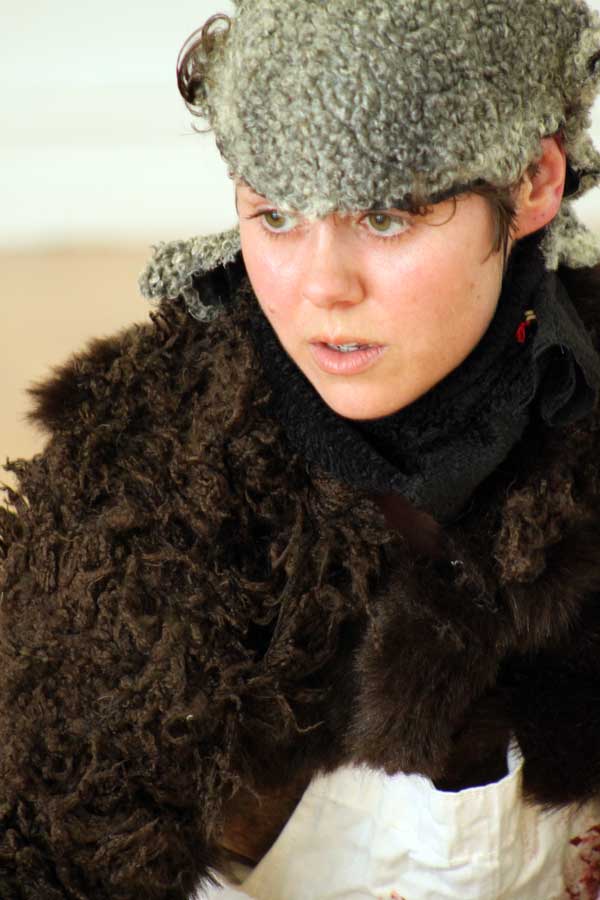
Dance and performance artist Carrie Ahern brings a whole new meaning to the phrase “you are what you eat” with her current project that delves into the connections between humans and the animals that many of us consume.

“For years, this question about sustainable food had been bothering me,” says Ahern, a Wisconsin native who moved to Brooklyn 17 years ago and currently resides in Ditmas Park. “I just felt so disconnected from going into a grocery store and buying a piece of meat and not really understanding where it came from.”

A growing interest in the origins of her food prompted Ahern to seek hands-on experience in the “farm to table” process back in 2010. The undertaking resulted in a bicoastal journey that involved hunting for Sika deer in the swamplands along the Eastern Shore of Maryland in the autumn of 2010 and then heading to Seattle, Washington a few months later to learn the art of butchering at Rain Shadow Meats. Ahern eventually spent a day slaughtering chickens at Stokesberry Farm in Olympia, Washington before returning to Brooklyn. Here, she has continued to perfect her butchering techniques at Williamsburg-based Marlow & Daughters.

Ahern’s forays into hunting, butchering and slaughtering serve as the main basis for her new work, “Borrowed Prey.” Though Ahern initially set out to better understand her own relationship with the “farm to table” process, the project took on a broader dimension during the course of her research.

“I felt like I really needed to be able to kill an animal if I was going to eat it… I really was so curious about what that experience would be like and if I would be able to eat meat after it,” Ahern notes. “But what ended up happening right away is I realized it is a project about empathy, more than anything. And it is a project about connection.”

The performer is creating “Borrowed Prey” as a diptych, with part one focusing on human-to-animal empathy and part two centering on human-to-human empathy.

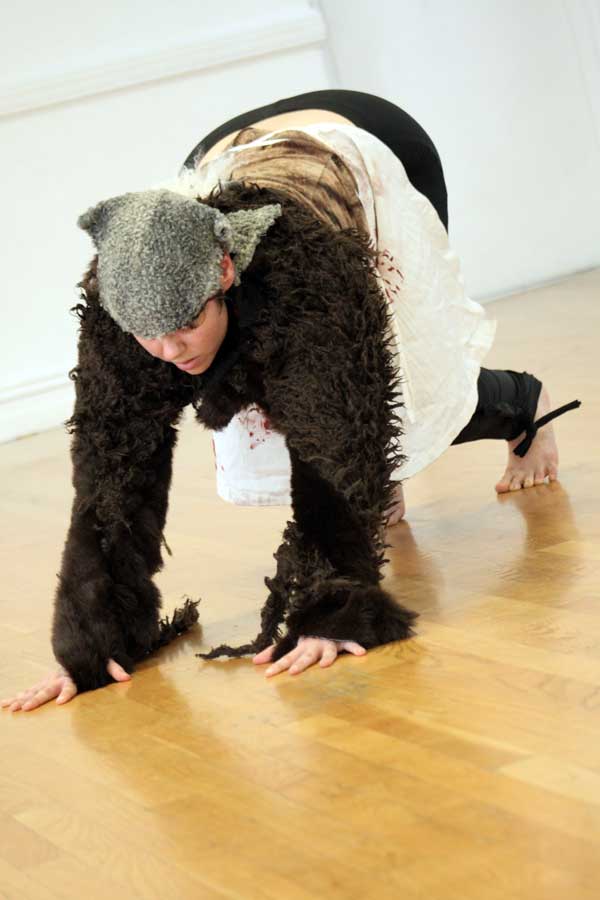
Ahern began choreographing the first part of “Borrowed Prey” during her stay in Seattle last year, often walking straight to her studio after a shift spent carving up carcasses at Rain Shadow Meats. There, her roles as researcher and dancer became fascinatingly intertwined, as Ahern explains. “I started making the movement when I started the butchering,” she says. “So it comes directly out of my experience with all the research… putting it in my body and seeing what would come out.”

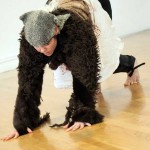
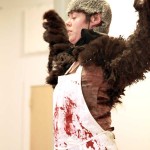
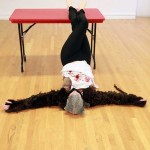
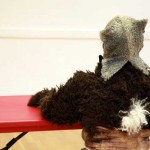
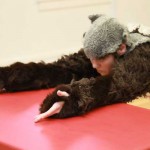
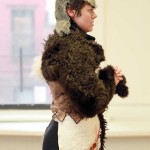
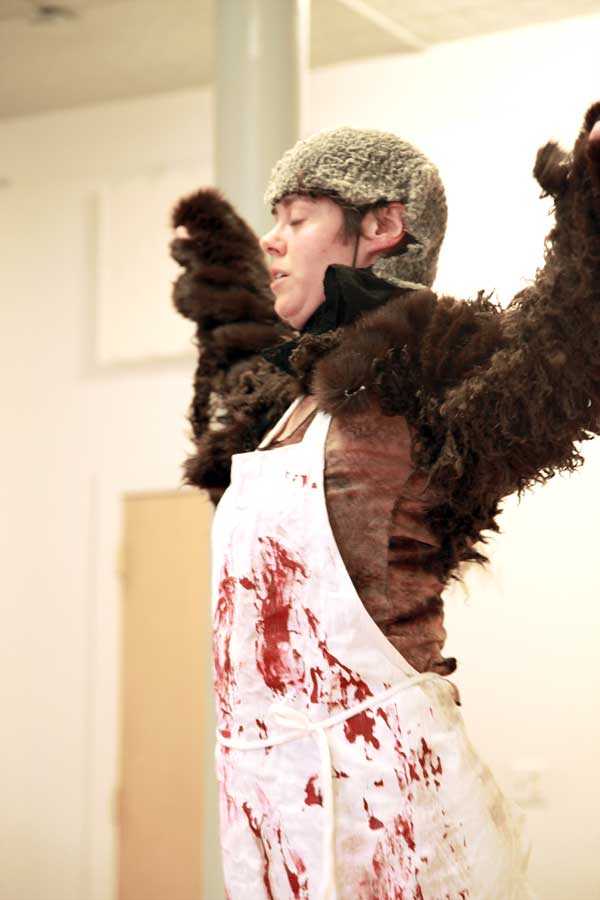
The result is a stunning work in which Ahern embodies both predator and prey, right down to her costume by Naoko Nagata that pairs a woolly, pointy-eared hood and furry shrug with a butcher’s apron splattered with fake blood. During a rehearsal at Brooklyn Arts Exchange in Park Slope, Ahern skillfully shifted from the limp stillness of a carcass on a butcher’s table to the playful strokes of a cat toying with a mouse to the skittish hops of a scared deer. Her movements were accompanied by a hauntingly beautiful score by composer Anne Hege that eventually gave way to an eerily distorted recording of Ahern reading text by Dr. Temple Grandin.

Grandin, an autistic and renowned animal behavior scientist, played an important role in the creation of Ahern’s new work. The scientist’s published findings serve as the fourth strand of research (along with Ahern’s hands-on studies of hunting, butchering and slaughtering) that informs part one of “Borrowed Prey.”

“Temple Grandin helped to answer some of the questions that we have about us versus animals,” Ahern notes. “Do animals think? Do they feel?”

Ahern hopes to get people thinking about these questions and many more by taking them along on a 55-minute sensorial journey filled with dance, music, spoken word, interactive touch experiments and open dialogue that leads up to the butchering of a lamb at the conclusion of the work.

The setting for Ahern’s upcoming performances will also provide rich stimuli, as the show will take place inside an actual butcher shop – Dickson’s Farmstand Meats – complete with pungent orders, a massive sausage grinder and a hefty butcher block that will serve as the dancer’s stage at times. Ahern plans to add her own touches to the space with the help of set and lighting designer Jay Ryan. Even such simple decorations as rawhide bundles dangling from the ceiling will serve to further Ahern’s examinations on the inescapable cycles of life and death, as she plans to fill them with decomposing flowers.

“Every aspect of the project is trying to get people more connected,” Ahern says. “It’s not that we just don’t ethically understand where our food comes from, it’s also that we’ve lost something in culture because we don’t participate in that process… by having a connection and empathy, there is more of a wholeness to our lives.”

Ahern will be performing part one of “Borrowed Prey” at Dickson’s Farmstand Meats in Chelsea Market on select nights from April 26 – May 13. Tickets are available for purchase at Brown Paper Tickets.


Photos by Lori Singlar for the Brooklyn Bugle


From the Web

Music

Brooklyn Bugle Pals The Kin Add Their Voice to World Malaria Day

April 25, 2012

April 25 is World Malaria Day and Interscope Recording Group (and Brooklyn Bugle Sessions alum) The Kin lend their song, “Waking Up Shining” to this powerful viral video. Spearheaded by The Backplane team to advance the important advocacy objectives of the Special Envoy for Malaria at the United Nations, the goal is to scale the web’s largest social systems to ensure the message of #endmalaria reaches the largest audience possible.

The hope is that you will join together in advocating ending Malaria over the next 48 hours. To do so, simply tweet, post or share content that carries the hashtag #endmalaria. The video is designed to be posted to Facebook, Twitter, Google+, and Tumblr.

From the Web

Books

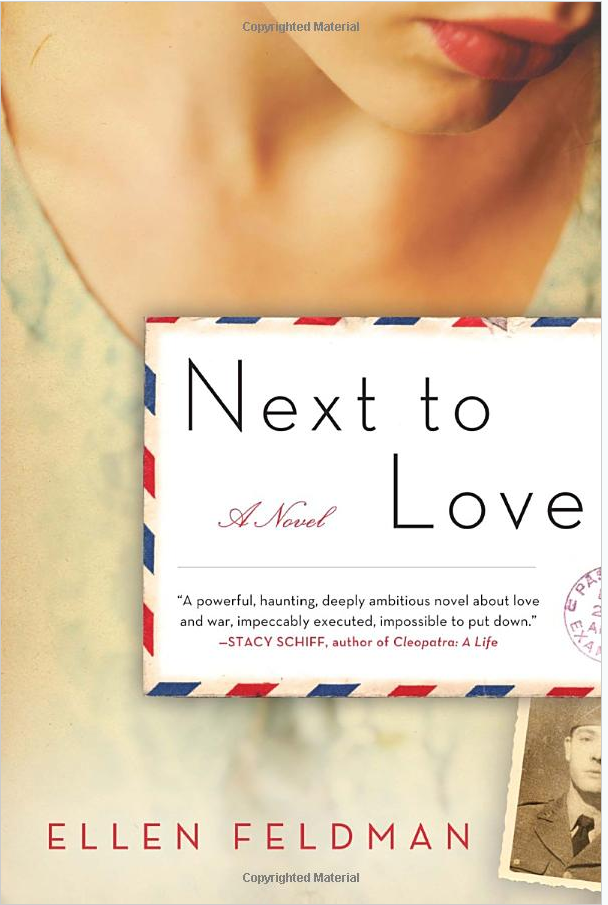
Brooklyn Bugle Book Club: “Next to Love” by Ellen Feldman

April 23, 2012

Photo source: Amazon.com

The title of Ellen Feldman’s novel is ascribed to Eric Partridge, the British lexicographer, who, as a young recruit, wrote of “war, which, next to love, has most captured the world’s imagination.” In the novel, Babe Huggins works for Western Union, snipping lines of telegram tape as they chug from the receiver, then gluing them in order onto light slips of paper before handing them off for delivery. The book opens on the harrowing day in 1944 when 16 telegrams from the War Department, each announcing a casualty, arrive in her small Western Massachusetts town. Since her own husband, as well as the young husbands of her two best friends Grace and Millie, are fighting in Europe, Babe feels a clutch of fear and a burst of relief as each name of a dead soldier comes across the wire.

“Next to Love” follows the three young women as they and their husbands grow up into a world at war. And while the book is about death, but it’s equally about sex:

Babe does not take long to learn the dirty little secret of war. It is about death. Everyone knows that. But it is also about sex. The two march off to battle in lockstep.

Her discovery is not original. Eros and Thanatos, she will read later . . . But Freud did not have her firsthand experience.

All three of the young women experience sex and marriage (sometimes in that order); all three are war brides. You will have guessed that at least one learns she is widowed on that day in 1944, but the book is not all about that. It’s about the effect of the war on these young women, and the children they will have, and the fathers of those children. And the burdens that the men who do return bring home with them.

In some ways, the war was liberating for women. In “Next to Love,” Babe leaves her Massachusetts home, following her husband Claude to training camp. She returns home when he is shipped overseas. She gets the job at Western Union because nearly all the men are away, but learns as the war winds down that she must give up her job once it’s over – the returning men will need all the jobs. It seems hard to explain now, the fact that only a few women stayed in the workforce in 1945, the rest easily giving up their jobs to the men.

All the same, it’s refreshing to read a book about the home front during the war, one that deals with the hardships then and in the aftermath: the secrets, the repression, the relationship of stepfathers to children who never got a chance to meet their biological dads. And this is a well-written one. Do you agree? Let us know in the comments.

Have a book you want me to know about? Email me at asbowie@gmail.com. I also blog about metrics for people who hate numbers here.
From the Web

Events

Cobble Hill Tree Fund Hosts Annual Plant Sale Saturday April 28

April 21, 2012

The Cobble Hill Tree Fund is hosting its annual fundraising Plant Sale on Saturday April 28, from 10:30 a.m. to 2 p.m. in Cobble Hill Park at Clinton & Congress streets. In case of rain, the event moves to Sunday April 29.

A wide variety of annuals, herbs and perennials will be available, as well as geraniums and hanging baskets. For the kids, the Tree Fund will offer the Plant Identification Treasure Hunt in the park, with winners receiving a free plant. Information is also on-hand about the Cobble Hill Tree Fund and composting.

The Fund is also looking for volunteers for Saturday’s event. Contact info is here. Take a look at the event flyer here.

The Fund is dedicated to planting trees, providing education on the care of trees and the ongoing beautification of the community. Over a 50-year lifetime, a tree generates $31,250 worth of oxygen, provides $62,000 worth of air pollution control, recycles $37,500 worth of water and controls $31,250 worth of soil erosion.

Call Georgia Willett, Co-chair of the Cobble Hill Tree Fund with further questions: 718-237-1585.


Source: Cobble Hill Blog
http://cobblehillblog.com/archives/7079

From the Web

Books

Brooklyn Bugle Book Club: “The Best Exotic Marigold Hotel” by Deborah Moggach

April 20, 2012

Source: Amazon.com

Until I came across a copy in the local branch of the Brooklyn Public Library, I had no idea that “The Best Exotic Marigold Hotel,” now a Major Motion Picture starring a slew of great British actors, started life as a book. But indeed it did, in 2004, and the book has just been reissued to tie in to the movie, with a bright orange-yellow cover. So of course I picked it up.

The story opens in London, where elderly Muriel has been getting a lot of publicity after having been left in an the emergency room cubicle of a crowded London hospital awaiting a bed. Her exhausted Indian doctor, Ravi, goes home to find that Norman Purse, his English father-in-law, has moved in. Norman has been kicked out of his most recent nursing home, for unspecified but easily imaginable misbehavior. As tensions rise between Ravi and his wife, Ravi and his cousin Sonny cook up a plan to develop a retirement home in India and eventually, though for very different reasons, both Norman and Muriel end up there. So do a married couple, the Ainslies, a BBC retiree named Dorothy, a Sussex widow named Evelyn, and various other single or widowed ladies.

Once they arrive, the new residents are taken care of by a manager who may or may not have their best interests at heart, a staff of decrepit retainers, and a former assistant to a podiatrist (it takes them some time to understand why the Best Exotic Marigold’s staff nurse, the manager’s wife, is interested mostly in their feet). They are subject to cross-cultural mishaps and some very funny misunderstandings. But in the best British tradition, they muddle through and make a go of things.

The book makes some gentle comparisons between Indian and English ways of treating the elderly, not to mention comparative ways of viewing poverty. There is personal growth, especially among the retirees; there is a bit less among their needy adult children. Things end happily for some, less happily for others, and a few souls go gently into that good night (well, many of the characters are elderly).

As you can tell, the new edition features famous British actors on the cover. I’ve yet to see the movie, (and I haven’t seen the trailer again since I read the book) so I am having a good time guessing which actor plays which character. Bill Nighy would be entirely in character as Norman Purse, but maybe he’s cast against type and is Doug Ainslie? Maggie Smith must be Evelyn, there just isn’t any other role for her. Judi Dench might be Muriel, or Mrs. Ainslie, or she could be Dorothy. Of course, movies being what they are, the entire story might have been rewritten with changed emphasis, so all my guesses might be wrong.

What do you make of my predictions? The book? Have you seen the movie? Let us know in the comments.

Have a book you want me to know about? Email me at asbowie@gmail.com. I also blog about metrics for people who hate numbers here.

From the Web

Food

‘Serious Eats’ Returns To Cobble Hill, With High Marks For Spanish ‘La Vera’

April 19, 2012

Serious Eats seems to have some serious love for the ever-evolving restaurant scene in Cobble Hill. A week after serving up a loving review of intimate eatery Battersby (255 Smith Street), the webbie is licking its chops over La Vara, a new Spanish restaurant at 268 Clinton Street, which explores the Moorish and Jewish flavors of Spain.

According to the Serious Eats review, husband-and-wife chef duo Alex Raij and Eder Montero offer “a welcoming vibe for both family meals and date nights alike, with a menu ranging from snacky nibbles to bigger entrée plates.”

Read the full review here, with a slideshow of menu items that will likely have you running in for a taste… So far, it appears the restaurant has no website of its own.

(Photo: Serious Eats)


Source: Cobble Hill Blog
http://cobblehillblog.com/archives/7053

From the Web

Events

Reminder: Squadron’s Community Convention Sunday

April 19, 2012

State Senator Daniel Squadron will host his fourth annual Community Convention this Sunday, April 22, from 2:00 to 5:00 p.m., at the High School of Economics and Finance, 100 Trinity Place (one block west of Broadway, between Cedar and Thames Streets), in downtown Manhattan. The keynote speaker will be MTA chair and Brooklyn Heights resident Joseph Lhota. After the opening ceremonies and keynote speech, you’ll be invited to participate in discussion groups on issues of community concern. If you’d like to attend, please RSVP here, where you’ll also find a list of topics for discussion groups, or call 212-298-5565.


Source: Cobble Hill Blog
http://cobblehillblog.com/archives/7075

From the Web

Boerum Hill Resident Tracy K. Smith Wins Pulitzer Prize For Poetry

April 19, 2012

Boerum Hill resident Tracy K. Smith has won the 2012 Pulitzer Prize for poetry for her collection “Life on Mars,” which the prize committee called “a collection of bold, skillful poems, taking readers into the universe and moving them to an authentic mix of joy and pain.”

There was plenty for Smith to celebrate when she discovered the news of her award April 16: It was also the Princeton University Assistant Professor’s 40th birthday. Published by Graywolf Press in 2011, “Mars” is Smith’s third published book.

In its review, The New York Times notes, “Smith is quick to suggest that the important thing is not to discover whether or not we’re alone in the universe; it’s to accept—or at least endure—the universe’s mystery. Publishers Weekly says “Life on Mars” “blends pop culture, history, elegy, anecdote and sociopolitical commentary to illustrate the weirdness of contemporary living.”

The prize-winning collection follows Smith’s 2007 “Duende,” which won the James Laughlin Award from the Academy of American Poets and the first Essence Literary Award for poetry; and 2003′s “The Body’s Question.”

(Photo: New York Daily News)


Source: Cobble Hill Blog
http://cobblehillblog.com/archives/7069

From the Web

Cobble Hill Association Calling for Executive Board Candidates

April 18, 2012

The Cobble Hill Association has issued an open call for nominations to form its new Executive Board of officers for the 2012-2014 term. Its Nominating Committee invites any interested residents to join an open meeting Monday, April 30 at 7 p.m. in the Cobble Hill Community Room at 250 Baltic Street, off Court Street.

Please come with questions and ideas, so that the committee can discuss interested individuals’ potential for filling one of the seven positions on the executive board.


Source: Cobble Hill Blog
http://cobblehillblog.com/archives/7050

From the Web