Monthly Archives

April 2012

Events

Curious About Liquor Laws and Licensing?

April 11, 2012

This in from Community Boards 2 and 6:

Ever wondered why your favorite watering hole doesn’t use its outdoor space or why they won’t let you dance on the bar? Also, why is the trash pick-up always late at night and how does a liquor license get approved?

These questions and more will be answered at the community meeting hosted by Community Boards 2 and 6 on:

April 12, 2012; at 6:00 p.m.
250 Baltic Street
(Court & Clinton Streets) Auditorium

This is a neutral forum designed to clarify questions, and will be conducted as an informal questions and answer session.

Representatives from State Liquor Authority, city agencies and local precincts will be on hand to answer questions in respect to noise, smoking, outdoor usage, garbage and other related issues.

Unfortunately, drinks will not be served.


Source: Cobble Hill Blog
http://cobblehillblog.com/archives/7010
From the Web

Books

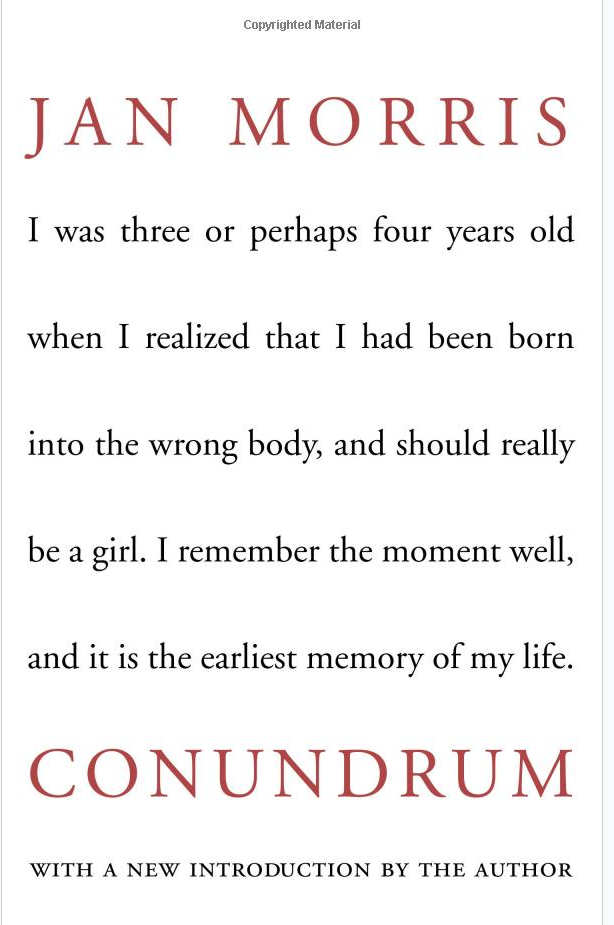
Brooklyn Bugle Book Club: “Conundrum” by Jan Morris

April 9, 2012

A few weeks ago I reviewed Jan Morris’s novel “Hav.” Reading that book and her book about Sydney, Australia, made me more curious about Morris, one of the earliest and best-known personalities to undergo gender reassignment surgery. So I read her book “Conundrum,” published in 1974 (and reissued in 2002). “Conundrum” begins with a vignette of the little boy James Morris, aged three or four, realizing “that I had been born into the wrong body, and should really be a girl.” In what is deeply felt and surely the most graceful of writing about transsexuals, Morris explains how she moved from James Morris to Jan Morris.

This book is the only vehicle Oxford-educated, Army-serving, Everest-climbing Morris has used to explain a story that riveted interest across the world. After the initial insight, Morris assumed nothing could be done about this conundrum, and describes a childhood and young adulthood of keeping a secret while attending the choir school of Christ Church, Oxford, and public school at Lancing. As James, Morris went into the Army at 17 during World War II, describes himself, “like a spy in a courteous enemy camp . . . caught up in the fascination of observing how the other side worked.” Morris put these observations to good use, building on them to become a writer. There was clearly sexual ambiguity, though as James, Morris married (and fathered five children). Morris clearly owes a huge debt of emotional gratitude to her children, who are described empathetically but whose privacy is carefully respected, and to her former wife (now her partner in a civil union). The book, while deeply felt, also skates across what must have been some thin emotional ice as Morris allowed her femininity to emerge, first through drugs, and then through several surgeries.

Morris’s sense of humor is evident throughout the book, particularly during the years when she had begun hormone therapy and was intersexual, sometimes appearing as male, other times as female. Morris clearly enjoys the pleasures of femininity, to an extent that, from the vantage point of 2012, is a little disturbing to a feminist – she writes of the comfort of slipping into being cared for from being the one doing the caring, in terms of doors opened and bags carried. As she acknowledges, she has missed the full experience of periods and pregnancy. And she movingly describes the process of moving towards acceptance of her often confusing self, suggesting that she must have suffered some serious depression. Since the book’s publication, Morris has not written or spoken much about the surgery, letting the book speak for itself. She makes the point that the process did not change her as a person, except in outward form; after the surgery she felt integrated and that she had gained her identity.

Morris has discussed in an interview with the Paris Review whether her sensibilities were changed. It’s a complicated answer, so I am quoting the question and answer in full:

INTERVIEWER
The very heart of this question is: do you feel your sensibilitiies at all changed?

MORRIS
That is a different question. The trilogy: I started it and finished it in the same frame of mind. But I suppose it is true that most of my work has been a protracted potter, looking at the world and allowing the world to look at me. And I suppose there can be no doubt that both the world’s view of me and my view of the world have changed. Of course they have. The point of the book Pleasures of a Tangled Life is to try to present, or even to present to myself what kind of sensibility has resulted from this experience. I’m sick to death of talking about the experience itself, as you can imagine, after twenty years. But I’ve come to recognize that what I am is the result of the experience itself. The tangle that was there is something that has gone subliminally through all my work. The one book I think isn’t affected is the “Pax Britannica” trilogy.

(Morris began “Pax Britannica,” a three-part history of the British Empire, as James, and completed it as Jan.) Let us know your thoughts in the comments.

Have a book you want me to know about? Email me at asbowie@gmail.com. I also blog about metrics for people who hate numbers here.

(Image source: Amazon.com)

From the Web

Books

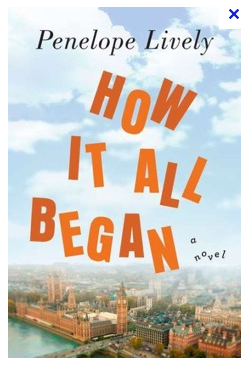
Brooklyn Bugle Book Club: “How It All Began” by Penelope Lively

April 6, 2012

A mugger pushes 70-something Charlotte, who teaches English to immigrants, over on the sidewalk, breaking her hip and setting off a chain of consequences in lives that should be unrelated. Charlotte’s married daughter, Rose, is unable to accompany her elderly employer, retired academic Lord Henry Peters, to a speech out of town, so his niece Marion goes instead. Marion and Lord Peters miscommunicate, and his speech and the train tickets are left behind. Marion sends a text changing some plans to her married lover, and his wife reads the text – he has left his phone in his jacket pocket. Lord Peters is unable to reconstruct or recite his speech and so humiliates himself. At the luncheon before the disastrous speech, Marion is seated next to a charming hedge fund manager, and he hires her to decorate an apartment for him. Since she can no longer go out to teach her classes, Charlotte has one of her students come to Rose’s house for tutoring. He and Rose become friendly and. . . you get the idea.

Many unexpected consequences ramify in all sorts of directions and dimensions from these beginnings, and all the characters’ lives are changed as a result. Lord Peters, for example, spends much of the novel plotting to find a way back into the public eye. Since his chosen vehicle is television, things do not go quite as he had hoped. But his efforts create an opportunity for Mark, a young researcher who is clearly on the make. Marion thinks that she has hit pay dirt with her hedge fund manager until he stops returning her calls and, more relevantly, paying her bills. Marion’s lover and his wife struggle on, unable to divorce, unable to resolve their issues. Things work out well for some characters, and turn out in unexpected ways for others – ‘How it all Began’ is not a dark story. The mugger appears only briefly, on the first and last pages, an elfin figure who sets the plot in motion and is then of no further interest to any of the others whose lives he has upended.

Though the writing is blithe and, well, lively, this is not a glib novel by any means. It provides a thoughtful view of a cross-section of contemporary English life. We get a peek at a fairly broad swath, from the Upper Middle Class (unless his life peerage thrusts Lord Peters into the upper classes) through to the rough working class life of economic immigrants working construction jobs. Penelope Lively has a strong grasp of her craft, switching points of view readily and keeping the plot moving along nicely. This is a perfect book to give a convalescent, and is a pretty good option for a plane.

Have a book you want me to know about? Email me at asbowie@gmail.com. I also have a blog making numbers palatable to people who hate numbers here.

From the Web

History

FASCINATING: 1940 Census Data Reveals Who Lived In Your Digs

April 6, 2012

Ever wondered who was cooking pot roast on your antique stove in 1940? Who hid that stamp beneath the floorboards when you were gutting your Pacific Street coop bedroom? How much that Degraw Street apartment cost to rent 70 years ago? Now’s your chance to find out. In partnership with Archives.com, the U.S. National Archives released Census records from 1940 online on April 2—comprising 3.8 million images scanned from some 4,000 rolls of microfilm.

The website offers access to maps and hand-written info about every known address in all 48 states in the Union, allowing you to find census maps and descriptions to locate an enumeration district, browse census images to locate any household interviewed in the 1940 Census and then save and/or download images. The Search page is here.

Warning: The site is slow, if not clunky, as hundreds of thousands are discovering this fascinating window to the past all at once. It’s also a bit unnerving to navigate. The best tutorial I found is at Gawker.com here.

Happy hunting! Be sure to share anything revealing with all your friends here on the Cobble Hill Blog. We’ll also be scouring for tidbits over the next several weeks.

(Image: Gawker.com)


Source: Cobble Hill Blog
http://cobblehillblog.com/archives/7004

From the Web

Food

Cobble Hill Resident Alan Cooper Launches New Restaurant In Fort Greene

April 6, 2012

Two 2001 graduates from Brooklyn Heights’ Packer Collegiate Institute—one of whom grew up in Cobble Hill—are staying true to the borough by opening an American restaurant in nearby Fort Greene. Pals Alan Cooper and Stephen Cohen plan to launch Prospect Restaurant at 773 Fulton Street in July, in the space of recently closed Mediterranean Aqualis Grill.

The pair was interviewed April 5 in the New York Times blog “The Local,” after the eatery’s license was approved by the Community Board 2 Health Committee. The spot will offer 53 seats and a full bar, serving dinner seven days a week and brunch on weekends.

The co-owners told the Times that their venture—the first restaurant for each of them—will offer fresh, seasonal ingredients. “We’ll have a serious menu, but you won’t look at the plate and not know what’s on it,” said Cooper, who was raised in Cobble Hill (on left in photo). The pair added that they chose the location because of their ties to the community: “I live in Fort Greene now and knew this was a great, accessible location. I wanted to be in the kind of brownstone community that I grew up in,” Cooper added.

The Prospect Restaurant at 773 Fulton Street, is between South Portland Avenue and South Oxford Street.

(Photo: Linda Villarosa for The New York Times)


Source: Cobble Hill Blog
http://cobblehillblog.com/archives/7000

From the Web

Health, News

Cruise Ship Air Pollution Response Stalled

April 4, 2012

A year ago, Mayor Bloomberg announced a deal to eliminate air pollution resulting from cruise ships having to run their diesel generators to supply power while docked at the Red Hook terminal. Under the agreement, the parties involved: the Port Authority, the suppliers and distributors of electricity, and the cruise line, would share the cost of installing and maintaining equipment allowing ships to take power from shoreside. Now, it appears, that deal has collapsed, and local residents will have to continue to breathe fumes from the ships’ generators.

New York Daily News Cruise ships docked in Brooklyn continue to choke Red Hook with their fumes — despite a widely touted deal a year ago that was supposed to solve the problem.

The Port Authority approved $15 million to build a system allowing ships to plug into an electric grid — but costs have shot up another $4.3 million and the agency hasn’t shelled out the extra money, according to local elected officials.

The Daily News story quotes Congresswoman Nydia Velazquez and other local elected officials as noting that “[a]sthma rates among Red Hook youth are high”. Red Hook resident Adam Armstrong, author of the blog A View from the Hook, accuses the Port Authority of “twiddling their thumbs.” A Port Authority spokesman says the agency is “evaluating options”.


Source: Cobble Hill Blog
http://cobblehillblog.com/archives/6990

From the Web