Monthly Archives

June 2012

Brooklyn Heights, Downtown Brooklyn, History, Landmark Preservation

Backtrax: Downtown’s Martin’s Dept. Store & Offerman Building

June 23, 2012

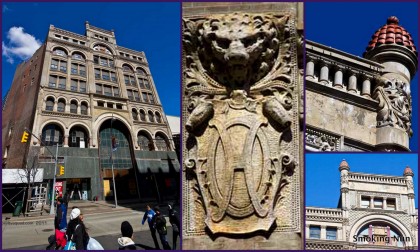
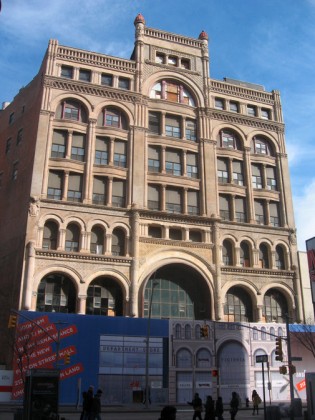
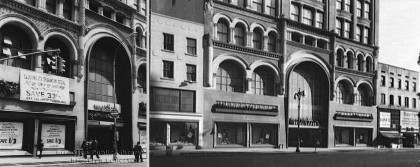
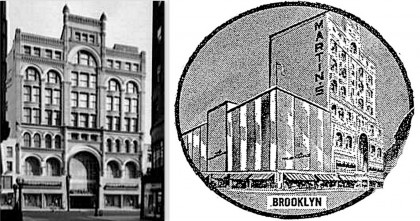
As the Landmarked Romanesque revival Offerman Building along Fulton Street Mall continues buildout of TJ Maxx and a bevy of boutique stores—alongside H&M’s new-construction two-story glass modernist structure—it’s high time to take a look back at the history of the storied location at 505 Fulton Street.

Its life began in 1891, commissioned by mogel Henry Offerman, who owned the Brooklyn Sugar Refining Co., on the waterfront in Williamsburg, Brooklyn. His Downtown “highrise” opened as one of the tallest buildings in Brooklyn. The Wechsler Department Store operated in the space until 1897; with Darlington’s Department Store scheduled to take its place in 1907, until developer Kingston Realty went belly up before the location ever opened.

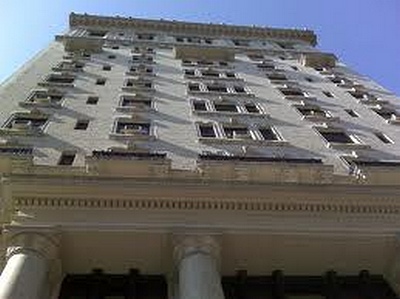
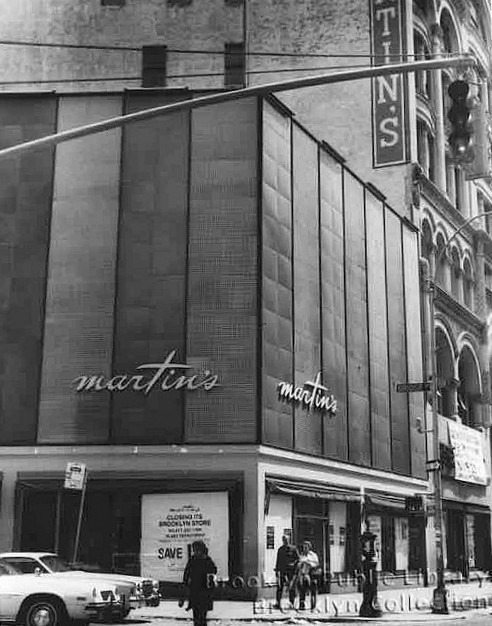
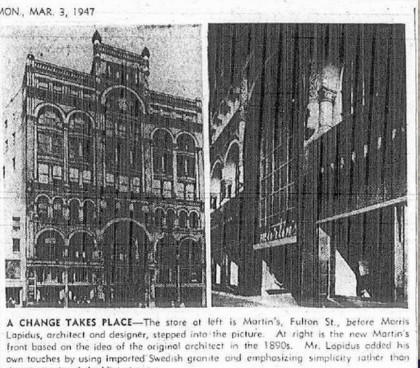
But its fortunes were soon to change for the long term. Hyman Zeitz, who had emigrated to the U.S. in 1882, opened a coat & suit department in an existing blouse shop called Martin’s at Fulton & Bridge Street. The business burgeoned and in 1924, Zeitz bought out Martin’s owner and moved next door to the seven-story Offerman Building, comprising 225,000 square feet. The cutting edge locale offered its own electrical generator and pneumatic tube system for moving cash through the store.

As Brooklyn’s Downtown Fulton district flourished, Martin’s ushered other major department stores to the neighborhood, including A.I. Namm & Son and Abraham & Straus (today, Macy’s). In the 1950s, Martin’s opened additional locations in the New York suburbs: Garden City, Babylon, Suffolk County, Hackensack, N.J., and Huntington. The latter store was 75,000 square feet and offered a 500-seat community room for civic meetings, making it the largest branch store at the time.

In October 1977, with annual sales of $30 million, Martin’s was sold to the Seedman Merchandising Group, operator of Times Square Stores. Unfortunately, their vision for the future differed, and in 1979 the Fulton Street store was closed because of “long-term unprofitability.” In hand, the downtown Brooklyn shopping district, which once catered to the borough’s affluent, “was no longer related to the surrounding shopping area,” the company surmised.

Soon after, the remaining Martin’s either closed or changed names, while the Offerman Building was designated a New York City Landmark in 2005. Throughout that decade, it housed job agencies, the MTA adjudication Bureau and discount retailer Conway (which moved to a new location on Fulton in 2010). Its last retailer was a temporary seasonal Christmas discounter in late 2010, before it was sadly boarded up.

And then came new life to the Downtown Fulton shopping district. An interconnected three-story annex to the east along Bridge Street was demolished to make way for Swedish retailer H&M’s first Brooklyn location in a new shiny glass two-story structure. Offerman, meanwhile, will house TJ Maxx, with hints of such upscale retailers of Ralph Lauren, Calvin Klein and Giorgio Armani on signage outside. The upper floors are said to be going residential, with rumors of interest by hipster Justin Timberlake.

Meanwhile, Downtown Brooklyn’s City Point up the block continues to take shape, first to comprise a four-story 50,000sf retail building on Albee Square across from the landmarked Dime Savings Bank building. In all, that project intends to encompass 1.5 million square feet of retail & residential.

It’s gratifying to see this beautiful 120+-year building find new life, as one of the most beautiful architectural triumphs on Fulton. Long live the Offerman Building.
Source: Brooklyn Heights Blog
http://brooklynheightsblog.com/archives/41858

From the Web

Books

Brooklyn Bugle Book Club: The Glass Room by Simon Mawer

June 22, 2012

Image via Amazon.com

Viktor and Liesel Landauer meet and marry in the late 1920s. They live in small city in the newly-formed Czechoslovakia, about an hour’s train ride from Vienna. The Landauers, both descended from wealthy families – his manufactures automobiles – commission an architect to design a house for them. The architect bemoans the fact that man has been “building caves! But I wish to take Man out of the cave and float him in the air. I wish to give him a glass space to inhabit.”

The author explains that the German word glasraum can mean glass room, or glass space, and adding one letter, making the word glastraum, changes the meaning to glass dream.

A dream that went with the spirit of the brand new country in which they found themselves, a state in which being Czech or German or Jew would not matter, in which democracy would prevail and art and science would combine to bring happiness to all people.The architect went on to build skyscrapers in America. As for the Landauers, Viktor is Jewish, Liesel is not, and Czechoslovakia was to be overrun by Nazis.

But the novel is less about the Landauers, and, as the title suggests, more about the Glass Room. After living there for nearly 10 years, with two servants, their own two children and, in time, a governess and her child, the Landauers flee to safety in Switzerland. Eventually they go on to Cuba, and then the United States. The Nazis take over the Glass Room, using it as the site of a laboratory dedicated to the scientific classification of human phenotypes. Later still, it becomes, under the Communists, a hospital gymnasium used for physical therapy for children with polio. Throughout, two characters stay near the house, Lanik, the servant, and Hana, Liesel Landauer’s best friend. Both of them survive and, perhaps, thrive under the successive invasions and regimes.

The Glass Room itself is a constant, not quite a hearth, but the scene to which the novel’s action returns over and over. A lot of life is seen in that room, almost as if the room is a stage: there are seductions, betrayals, dances, a rape. And return and recognition. The Glass Room, and the house, make a permanent impression on all who lived or worked in it, and on some visitors as well. And even though the house could be considered the main character, the book contains characters who are deeply engaging.

It did not take much digging to discover that the Landauer House is based on the Villa Tugendhat in Brno. The architect of that house was Mies van der Rohe. The book is illustrated with schematic drawings of the house; even better are the photographs, available here. (The house has been restored and opened to the public.) But wait until you’ve read the book, as Mawer does a great job evoking the house, its inhabitants, and its impact on their lives. Do you agree? Let us know in the comments.

Have a book you want me to know about? Email me at asbowie@gmail.com. I also blog about metrics for people who hate numbers here.

From the Web

Downtown Brooklyn, Events, Food

Dekalb Market Forced To Relocate In Fall As City Center Buildout Burgeons

June 21, 2012

Fans of the wholly original Dekalb Market are going to have to find a new weekend play date for their urban retail and foodie fix. The landlord of the Downtown Brooklyn space—which opened last year at Flatbush and Willoughby Avenues—has informed its operators that they must vacate the premises by October. In its place will be the next stage of the burgeoning mixed-use City Point project.

The founders of the Dekalb Market—which houses an emporium of 60 boutique shops and eateries constructed from salvaged shipping containers—says they are disappointed by the developer’s plan to begin construction this soon, after being led to believe they would have five years to utilize the former empty lot. According to Eater, there is no word yet on where the market might relocate, although one potential spot is a private parking lot across Gold Street.

The operators of Dekalb Market sent this letter to their vendors:

Dear Container Shops,
As many of you have heard, our landlord has given us notice that they will begin construction this fall and therefore, we will be moving Delalb Market to a new location. While we have not received official notice, we understand the Landlord’s construction may begin as early as October.
While we are disappointed that the Landlord’s new development plans moved as quickly as they did, we see this as a great opportunity for Dekalb Market. By positioning ourselves as the first shopping center in history to move and reopen in the space of a few weeks we will be able to have a new “re-opening” with both the press and operations. The move gives us an opportunity to learn from the first year and make improvements and towards this end we will be conducting a survey to make sure we capture everyone’s input.
We have identified a couple of sites that would be ideal for the market in the Brooklyn area and are diligently working to make the transition work. We hope you will be able to continue with the Market in its new incarnation. We will provide an updated report to the new site and details regarding the move shortly.

(Photo: Chuck Taylor)


Source: Brooklyn Heights Blog
http://brooklynheightsblog.com/archives/42813

From the Web

Cobble Hill Inspires The Design Of Kate Spade ‘Little Minka’ Handbag(?!)

June 21, 2012

Just in case you’ve ever wondered what the neighborhood of Cobble Hill would look like as, uh, a leather purse, Kate Spade has come to the rescue. The high-end designer has named its “Little Minka” handbag after the enclave.

The description: “Known for its expansive historic district and well-maintained 19th century homes, (Cobble Hill) exudes the classic ease and character that inspired this handbag. Crafted in soft pebbled leather with a short shoulder handle and a secure zip-top closure, it ensures all your belongings will stay safe and look sharp as you hop from one adventure to the next.” So how much is the neighborhood worth in Kate Spade currency: $378, thank you. See Kate Spade’s other Cobble Hill handbag selections here.


Source: Cobble Hill Blog
http://cobblehillblog.com/archives/7419

From the Web

Real Estate

Bank Coming To Dilapidated Carroll Gardens Lot At 232 Smith Street

June 21, 2012

A dilapidated empty lot at the corner of Smith & Douglass streets in Carroll Gardens is about to cash in on commerce. DNAInfo.com reports that the 5,000 square-foot space at 232 Smith Street is going to become the location of a bank.

The lot is owned by Son Claire Realty LLC, a limited liability company owned by Claire Palermo and her son, who confirmed that she intends to sell it to a banking chain. She declined further details. The pair has accumulated $150,000 in unpaid violations from the Environmental Control Board over the years for letting the derelict space become a hazard.

(Photo: DNAInfo.com)


Source: Cobble Hill Blog
http://cobblehillblog.com/archives/7413

From the Web

Arts and Entertainment, Events

‘Music In The Park’ Summer Series Comes To Cobble Hill Park

June 21, 2012

Cobble Hill Park will feature its 2012 “Music in the Park” concert series beginning July 5, with weekly free family-friendly performances beginning at 7 p.m. It’s sponsored by Ridgewood Savings Bank, Brooklyn Bridge Realty and park neighbors Ted & Honey.

Coming up: Thursday July 5: The Claremont Strings (Classical), July 12: Suzanne Sherman Propp (folk) and The Crustaceans (acapella w Colgate13 alumni), July 19: Zenon Garcia & Ada Pasternak (folk-jazz combo) and July 26: singer/songwriter Kelly McRae.

Rain dates are the following Friday.


Source: Cobble Hill Blog
http://cobblehillblog.com/archives/7407

From the Web

Brooklyn Heights, Downtown Brooklyn

Bossert Not The Only New Hotel Around Town, As LodgeWorks Builds Downtown

June 21, 2012

As the Bossert endures community and governmental scrutiny to potentially convert the Montague Street property back to a “first-class” hotel, a national chain intends to build a 117-room inn on a now-vacant lot in Downtown Brooklyn. This spring, Kansas-based hotel developer LodgeWorks acquired 0.11 acres/4,700 square feet at 125 Flatbush Avenue Extension, just west of the Manhattan Bridge entrance. The Real Deal reported in March that it paid $7.75 million for the site.

Brian Dunne, director of marketing for Benchmark Hospitality International, which operates a Hotel 718 that is scheduled to open Downtown this summer, told The New York Times that with so much residential development, Downtown is becoming an evening destination, rather than a neighborhood that empties when workers go home: “Brooklyn isn’t being viewed as the less expensive option to Manhattan. It’s a place people are starting to want to come to first rather than second.”

LodgeWorks’ hotel plan follows a previous attempt to build a similar property there, which fell through in late 2010. The company manages properties for Hyatt Hotels, Hilton Worldwide, Starwood Hotels & Resorts and Wyndham Hotels & Resorts. CEO Greg Epp says the new hotel will be “a well-known national brand.” LodgeWorks has not determined when they will break ground.

Downtown Brooklyn has seen a boom of new lodging of late. The 176-room Aloft hotel opened last year and the 128-room Hotel 718 will soon open, which includes a spa, rooftop deck and restaurant. The Brooklyn Bridge Marriott on Adams Street, meanwhile, has been deemed the official hotel of the Barclays Center, according to the New York Times article.


Source: Brooklyn Heights Blog
http://brooklynheightsblog.com/archives/42795

From the Web

Brooklyn Heights

As Brooklyn Bridge Park Eases Forward, Parks In Greenpoint & Bushwick Stall

June 21, 2012

As progress on Brooklyn Bridge Park continues to ease forward—however controversial—other areas of Brooklyn are apparently not as fortunate. City officials admit that two stalled North Brooklyn parks will likely see little to no progress before Mayor Bloomberg’s term runs out in November 2012, because funding was allocated to other projects.

A long-promised waterfront recreation area in Williamsburg’s Greenpoint and a planned open space at Bushwick Inlet Park are both at risk of simply never materializing. The Brooklyn Paper reports that two top Bloomberg aides deflected a barrage of questions from Brooklyn council members over the projects, refusing to estimate when or if they might be completed, citing budget constraints. Parks Assistant Commissioner Joshua Laird: “We don’t have a bottomless pit of money. It’s just not possible to acquire property. The city has an obligation to its taxpayers.”

Open space advocates counter that the city also has an obligation to North Brooklyn after approving a controversial rezoning of 200 industrial blocks in Williamsburg and Greenpoint seven years ago in exchange for a commitment to build hundreds of affordable housing units, a mile-long esplanade abutting the East River and several new parks. Instead, a number of luxury residential towers have risen along the river’s edge.

For Bushwick Inlet Park, the city has only acquired half of the required lots to begins its buildout, while city budget planners reallocated $13 million of the $14 million intended for that park’s development for other projects. Bloomberg aides claim the city could raise funds by selling air rights to developers around adjacent commercial properties to fund the park.


Source: Brooklyn Heights Blog
http://brooklynheightsblog.com/archives/42746

From the Web

Brooklyn Heights, News

Bossert Plans Draw Cheers and Caveats

June 21, 2012

Update: Following last evening’s hearing, a majority of the Community Board 2 Land Use Committee voted to approve the new owner’s request for a variance to re-convert the Bossert to transient hotel use. The matter will now go to the full Community Board for consideration. We’ll keep you posted.

David Bistricer, buyer of the Bossert Hotel, was on hand for this evening’s hearing before Community Board 2′s Land Use Committee on his application for a variance to reconvert the grande dame of Montague to a “transient hotel.” While he didn’t speak, his attorney and several consultants offered these assurances: (1) it will be a hotel–indeed, a “sophisticated and upscale” (but not too upscale) hotel–not a dorm; (2) the beautiful lobby won’t be altered, but will become home to a first-class restaurant; (3) there will also be dining on the roof, but it will be very quiet; and (4) their studies of likely increases in traffic from guests arriving by taxi, limo or private car (they have an arrangement with Quick Park for valet parking service) and from delivery trucks indicate that the impact, compared with present conditions under Watchtower ownership, is not “significant.”

So, who liked it? The Brooklyn Chamber of Commerce, citing, among other things, the new owner’s “commitment to local hiring”; Glenn Markman, co-owner of Heights Cafe and soon-to-open Della Rocco’s, who said it will attract more business and perhaps more people to move to the Heights; Karen Johnson (who discovered she had a namesake in the audience), who “feels confident it will be done correctly”; the Montague Street BID, whose Executive Director, Brigit Pinnell, said the real comparison to be made was with alternative uses for the building, which include a dorm, a social services facility, or medical offices; and Borough President Marty Markowitz, whose spokeswoman said it will “help Downtown Brooklyn’s business community to thrive.”

Who had doubts? Brooklyn Heights Association Executive Director Judy Stanton asked what controls are in place to assure that this will be, and remain, a first class hotel. Consultant Jeff Klein said that the design, level of service, and room rates should do the trick. Ms. Stanton then noted that if the projections were wrong, there could be a large increase in taxi traffic. She also said she was concerned about guests arriving by private car; in particular, that they might have to wait in idling cars for valet service. Spokesmen for the buyer said that the assumptions made in the environmental assessment were “very conservative”, and that guests reserving rooms would be asked if they planned to arrive by private car, so that valet service could be scheduled to meet them.

Other cautionary messages came, unsurprisingly, from people living in the Bossert’s immediate vicinity. Several people from 200 Hicks Street expressed concerns. Richard F. Ziegler said the planned re-conversion “could be an asset [to the neighborhood] or an absolute devastating nightmare.” He found the statements made by the buyer’s attorney and consultants “confusing,” and said the residents of 200 Hicks had retained “high priced counsel” to represent their interests in the variance proceedings. Gretchen Dykstra, former City Commissioner of Consumer Affairs, expressed great concern about the rooftop lounge and dining area. She noted that a rooftop lounge at the Empire Hotel, also owned by Mr. Bistricer’s company, had become a venue for parties with DJs and loud music that went late into the night. When local residents complained, they were told that the owner wasn’t responsible; the space was leased to the organization[s] giving the parties. Kay Desai said more information was needed, and her husband, Rohit Desai, sternly warned Committee members that their failure to demand such information could be in violation of law.

Other neighbors with cautionary messages were David Green and Nils Larson, both Remsen Street residents. Mr. Green noted that the valet parking operation would result in an increase in traffic on Remsen because cars being taken from the hotel to Quick Park would have to go that way. Mr. Larson, a recent high school graduate, said he had grown up in Brooklyn Heights and always loved the neighborhood’s serenity. He has two much younger brothers who, because the local streets are safe, are able to walk to school and to squash lessons. He fears that the increase in traffic generated by the hotel may end that.

Photo: Brownstoner.


Source: Brooklyn Heights Blog
http://brooklynheightsblog.com/archives/42752

From the Web

Con Edison Reduces Power

June 21, 2012

Con Ed has announced a power reduction in certain areas of Brooklyn and Queens because of “equipment problems.” Your correspondent’s lights, in fact, flickered a short while ago (if you do lose electricity, call ConEd at 800-752-6633), which suggests that Brooklyn Heights may be one of the “lucky” areas. I’ve turned off unnecessary lights, shut off my stereo (which I didn’t realize was on although the CD my wife had been playing ended a while ago) and have throttled my A/C back. As for my computer? They’ll have to pry my cold, dead hands from the keyboard.

For more info, go to Con Ed’s website.


Source: Brooklyn Heights Blog
http://brooklynheightsblog.com/archives/42739

From the Web