Monthly Archives

July 2012

Events, Kids

Family Art Workshop at the Transit Museum this Saturday, July 14

July 10, 2012

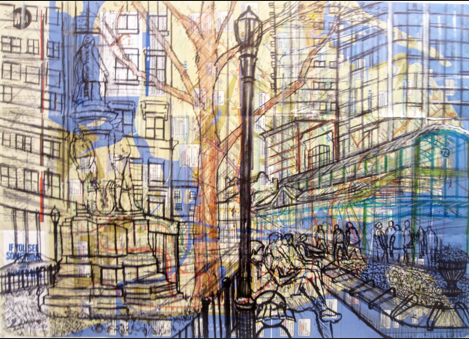
Family art returns to the New York Transit Museum on Saturday, July 14, this time with artist Enrico Miguel Thomas. Thomas draws scenes from the subway, using subway maps as background. On Saturday, Thomas will share the story of his two great passions – art and New York City’s subways – and then lead a drawing program for participants.

The workshop, which is free with museum admission, is for ages 8 and up. Reservations recommended – call (718) 694-1792.

The New York Transit Museum is located at the corner of Boerum Place and Schermerhorn Street in Brooklyn Heights.
From the Web

Brooklyn Heights, History, Real Estate

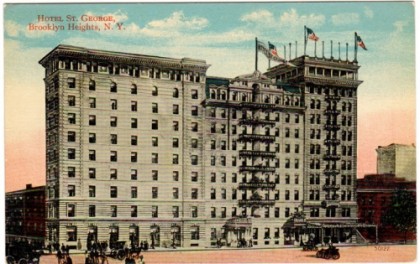
Heights History: A Room At The Hotel St. George, $10 A Week… In 1880

July 10, 2012

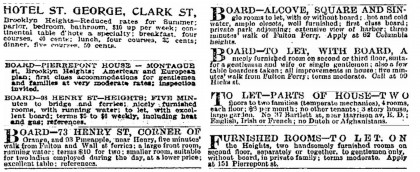
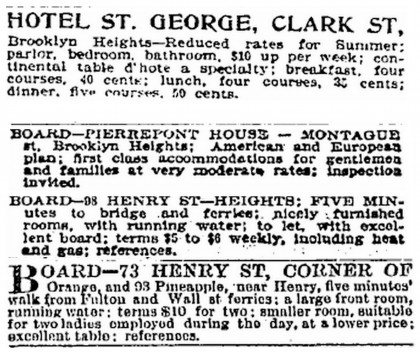
After going back in time to 1902 last month, we’ve given the Brooklyn Daily Eagle archives another spin into the past. This time we transport back to July 10, 1880, 132 years ago today…

What a deal! The Hotel St. George is offering special summer rates, for $10 a week. Your offer includes a bedroom, parlor and private bath, plus the option for a four-course breakfast (40 cents), four-course lunch (35 cents) and five-course dinner (50 cents).

Perhaps you’re looking for accommodations that are a bit more permanent. Sure enough, bargains abound. How about a nicely furnished room at 98 Henry Street, with running water, heat and gas: $5-$6 a week. Only five minutes to the Brooklyn Bridge and ferries to Manhattan.

Interested in first-class accommodations for gentlemen and families “at very moderate rates”? There’s the Pierrepont House on Montague Street [which today is the Bossert Hotel at 98], with your option of American or Europeans meal plans. There’s also a large front room with running water at 73 Henry Street, at the corner of Orange Street: $10 for two. A smaller room is also available that’s suitable for two ladies (as long as they’re employed during the day).

Here’s one that’s hard to resist: Alcove, square and single rooms to let with or without board, at 62 Columbia Heights. Includes hot & cold water, ample closets and furnishings—connected to a private park with an “extensive view” of the harbor. Or perhaps you’d prefer a nicely furnished room on the second or third floor of 99 Hicks Street, perfect for a “gentleman & wife” or single gent. And at 151 Pierrepont Street, you have a choice of one or two “handsomely furnished” rooms on the second floors of a private home. Sorry, gentlemen only and no meals.

And finally, a curiosity that’s not in Brooklyn Heights, but was so packed with prejudice, we’re including it as a sign of the times in 1880. Two floors are available to families, four rooms per floor in a three-story house, for $8 a month. The address is 37 Bartlett Street [in Williamsburg]: with a provision that the space is available only to “English, Irish or French; no Dutch or Afghanistans.” Is it ironic that in 2012, that address is an empty lot?


Source: Brooklyn Heights Blog
http://brooklynheightsblog.com/archives/43939

From the Web

Arts and Entertainment

Update: Lady Susan Moving to New Location

July 10, 2012

This Saturday’s (July 14) reading, presented by Theater 2020, of Lynn Marie Macy’s work-in-progress Lady Susan or the Captive Heart, a Jane Austen Bodice Ripper, originally scheduled to be held at the Brooklyn Heights Branch of the Brooklyn Public Library, has, because of the Library’s well known air conditioning problems, been moved to St. Charles Borromeo Church, 21 Sidney Place. It will be from 1:30 to 3:00 p.m.; admission is free and no reservations are required; and the playwright and actors will be available for a brief discussion afterward.


Source: Brooklyn Heights Blog
http://brooklynheightsblog.com/archives/43935

From the Web

Racked Highlights Two Smith Street Boutiques Among ‘Essential Shopping’

July 9, 2012

Alongside the likes of such ooh-la-la NYC retailers as Ralph Lauren, Barneys, Bergdorf Goodman and ABC Carpet, Racked has chosen two Cobble Hill boutiques among its July 2012 “38 Essential New York Shopping Experiences.”

The list offers a “north-to-south round-up” of destinations the shopping website declares “worth browsing,” adding, “We tried to include a range of neighborhoods, price points and merchandise, leaving out food stores and anything that’s been open less than six months.”

Epaulet at 231 Smith Street gets a Racked gold star for “staying on-trend without being too slavishly trendy.” Run by a married couple, the mostly-menswear shop “is perfect for guys who like knowing exactly how (and where) their jeans were made. There’s an Orchard Street shop too, but Smith Street is the original.”

As well, Dear Fieldbinder at 198 Smith Street is described as “a clean white box of a space stocked with hip labels like Rodebjer, Miista and Surface to Air. But don’t expect the service to be too cool for school. The staffers here are sweet and attentive and full of good styling ideas, and the denim sales can’t be beat.”


Source: Cobble Hill Blog
http://cobblehillblog.com/archives/7530

From the Web

Food

Cobble Hill’s Bien Cuit On Smith Street Garners Sweet Superlatives

July 9, 2012

With its ever-evolving selection of local eateries and novel boutiques, residents of Cobble Hill have come to know Smith Street as one of the most inviting corridors in South Brooklyn. It appears the word is out. In two separate surveys over the past week, pastry shop Bien Cuit at 120 Smith has been deemed one of New York’s best.

First, Eater offers a survey of New York’s 10 Best New Baked Treats. Bien Cuit reaps high praise for its Almond Croissants. The foodie webbie calls them “almond-y, flaky, buttery, golden-brown croissant perfection.”

Likewise, The Village Voice names Bien Cuit its No. 1 pick among the “10 Best Pastry Shops in New York,” saying: “Everything from this rustic Brooklyn bakery run by husband-and-wife duo Zachary Golper and Kate Wheatcroft is both pretty and delicious. Continue Reading…


Source: Cobble Hill Blog
http://cobblehillblog.com/archives/7522

From the Web

Books

Brooklyn Bugle Book Club: “Bring Up the Bodies” by Hilary Mantel

July 9, 2012

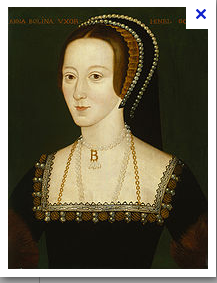
Image via Wikipedia.com

Bring Up the Bodies” is a follow-up volume to Hilary Mantel’s wonderful novel “Wolf Hall” (2009). Ending in approximately 1532, “Wolf Hall” described the life of Henry VIII’s advisor Thomas Cromwell up through the execution of Thomas More, Henry’s divorce from Katherine of Aragon, and his impending marriage to Anne Boleyn. In “Bring Up the Bodies” (the command to the Tower jailer to produce prisoners for trial) Mantel takes Cromwell up to the middle of 1536.

Spoiler alert – The demise of a main character is described in this paragraph – I’m always a little sad when I begin a historical novel about Anne Boleyn, because now that I’m old enough I feel so badly for the Boleyn parents, complicit in Anne’s well-plotted rise to Queen though they may have been. And that is because not one but two of their children were executed within a day or so of each other, after being found guilty of treason and incest. Were they guilty? At this point, we have no way of knowing, but that’s hardly the point. As Mantel puts it, “In this book I try to show how a few crucial weeks might have looked from Thomas Cromwell’s point of view. I am not claiming authority for my version; I am making the reader a proposal, an offer.”

As a portrayal of Cromwell, not one of history’s heroes (Mantel repeats a trope from “Wolf Hall,” that Holbein’s portrait of Cromwell makes him look like a murderer) this is a very sympathetic portrait, consistent with the rendering in “Wolf Hall.” Cromwell the character is an extremely able and competent minister to a mercurial king, maneuvering carefully among the many nobles and courtiers surrounding Henry. (It was Cromwell who managed Henry’s divorce from Katherine, and Cromwell who procures the annulment of Henry’s marriage to Anne.) He is also likable, and Mantel’s characterization of Cromwell as student of human nature is the best part of the novel. Here is her description of Cromwell thinking of his earlier employers: “Custom stales the intimacies of marriage, children grow truculent and rebel, but a good master gives more than he takes and his benevolence guides you through your life.”

It could be a description of Thomas Cromwell. He is a loving parent, and good master in his turn to his students and acolytes, one of whom, his nephew Richard, was great-grandfather to that other Cromwell, Oliver. And there are some lovely touches in the book, including a description of a jelly molded into the shape of a castle, “in stripes of read and white, the read a deep crimson and the white perfectly clear, so the walls seem to float. There are edible archers peeping from the battlements . . . “

But where “Wolf Hall” was candle-lit, with meaning flaring up here, or flickering into illumination there, “Bring Up the Bodies” is “Bring Up the Bodies” is more fluorescent. Mantel is clearer about certain things, such as the deaths (by plague) of Cromwell’s wife and daughters; the peacock feather wings, which in the earlier book signified the fleeting life of a daughter, make several more appearances in this volume, as themselves. The removal and trial of Anne was a complex political process, and Mantel is effective and clear in telling the story. But in doing so she has jettisoned some of the magic, making this book feel more labored than “Wolf Hall,” more reminiscent of her novel of the French Revolution, “A Place of Greater Safety.”

Cromwell survived in Henry’s employ for four more years after Anne’s execution. Mantel certainly suggests there will be a third volume. Mantel’s Cromwell is convincing and sympathetic, and I look forward to the next installment of her story. How do you feel “Bring Up the Bodies” compares with “Wolf Hall”? Let us know in the comments.

Have a book you want me to know about? Email me at asbowie@gmail.com. I also blog about metrics here.

From the Web

Brooklyn Heights, Food

Racked Names A Cook’s Companion Among Nine Best NYC Kitchen Suppliers

July 9, 2012

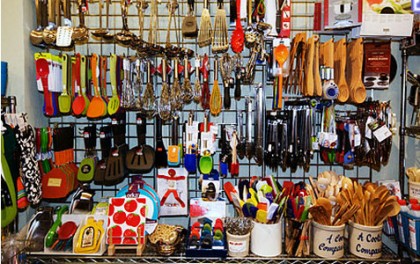
Shopping website Racked offers its take on “Nine Cooking Supply Stores for a Well-Stocked Kitchen,” and includes A Cook’s Companion at 197 Atlantic Avenue in Brooklyn Heights as a pick for “shops catering to the adventurous home cook.”

The site says of the popular destination: “A foodie’s dream, this Brooklyn shop offers quality goods, often at 10% below the retail prices of its across-the-bridge counterparts. The friendly staff often provides the final push you need to give into a craving for a new Wüsthof knife or All-Clad pot. And for the home pastry-chefs, be sure to stop by the store’s baking section, because who doesn’t need a martini-glass shaped cookie.”

The other eight shops: Fish’s Eddy, Kitchen Arts & Letters, Bowery Kitchen Supply, Broadway Panhandler, Sur La Table, Korin—all in Manhattan—along with the borough’s Brooklyn Kitchen and Whisk.


Source: Brooklyn Heights Blog
http://brooklynheightsblog.com/archives/43891

From the Web

History

Times Remembers Eagle’s Dennis Holt, Civil Rights Hero

July 9, 2012

In the Sunday New York Times Metropolitan section, Kevin Baker remembers his friend of many years, Dennis Holt, who died last month. Baker paints a colorful portrait of Holt as “a classic New York eccentric” who once chased an intruder from his Boerum Hill townhouse while brandishing a Civil War era dress sword.

Baker also discloses that, as a student government leader at the University of Alabama in 1956, Holt faced down thugs who rioted when an African American woman, Autherine Lucy, attempted to enroll there. He later sponsored a resolution “that mob violence be denounced at the University of Alabama and that means be found to protect the future personal safety of the students, white or Negro — and the faculty and the reputation of the university.” He was also a national collegiate debating champion. Who knew?


Source: Brooklyn Heights Blog
http://brooklynheightsblog.com/archives/43894

From the Web

Brooklyn Heights, History

Ephemeral New York Deems St. George Liquor Sign ‘One Of Coolest’ Vintage

July 9, 2012

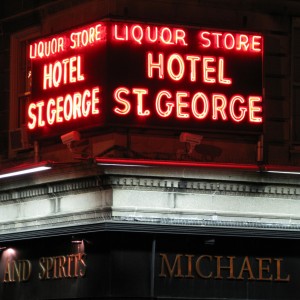
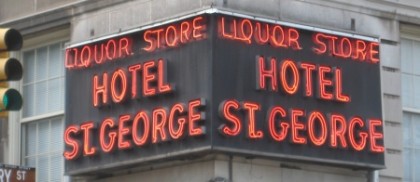
The always intriguing Ephemeral New York, which “chronicles an ever-changing city through faded and forgotten artifacts,” has deemed the neon sign outside the St. George Hotel one of “New York’s coolest vintage liquor store signs.” It joins age-old comrades in the West Village, 14th Street & Eighth Avenue and the Lower East Side.

Of course, there is no actual Hotel St. George Liquor Store today. The recently renovated Michael Towne Wine & Spirits at 73 Clark Street below the sign is anything but “shabby,” as Ephemeral describes the still-working red neon booze banner, adding, “You probably won’t find organic wines or imported microbrews in these old-school city liquor stores. Their shabby vintage signs tell us they’re traditional neighborhood shops where you can pick up decent booze at decent prices.”


Source: Brooklyn Heights Blog
http://brooklynheightsblog.com/archives/43875

From the Web

Arts and Entertainment, Brooklyn Heights, Celebrity Residents

Spike Lee Believes Cobble Hill Has Gentrified Into Brooklyn Heights

July 8, 2012

In a lengthy Q&A on New York magazine’s Vulture blog, Spike Lee talks with writer Will Leitch in detail about his roots in Brooklyn’s Cobble Hill. The director was born in Atlanta, and moved to Crown Heights at an early age, followed by eight years beginning around the age of 4—from 1961 to 1969—at 186 Warren Street, between Henry and Clinton streets.

Lee’s take: Cobble Hill has gentrified to the point that it’s now… Brooklyn Heights. Read more at Cobble Hill Blog.


Source: Brooklyn Heights Blog
http://brooklynheightsblog.com/archives/43864

From the Web