Monthly Archives

March 2013

Brooklyn Heights, Real Estate

One BBP Could Score Residential Record High Price For Heights

March 29, 2013

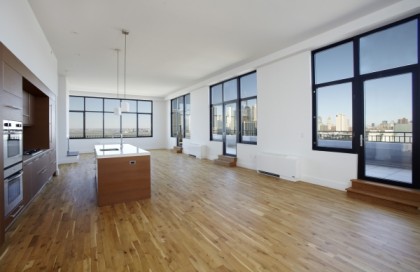
A combined penthouse unit and 3-bedroom 4-bath condo below at One Brooklyn Bridge Park could set a record-breaking residential price tag for Brooklyn Heights. According to a story in the New York Daily News, MNS CEO Andrew Barrocas is close to signing a $9 million contract for the duplex.

One Brooklyn Bridge Park, at 360 Furman Street, is located within Brooklyn Bridge Park across from Pier 6. “If sold, the combined unit would likely go to contract in the $9 million range, a record for a Brooklyn condominium,” reports real estate guru Jason Sheftell in the Daily News. Barrocas notes, “There is someone interested in combining a penthouse and the apartment on the floor below. What this says is the Brooklyn high-end is on fire. Prices are going one way, and that’s up. We’re having lots of bidding wars on the last few apartments left in the building.”

Listed at $4.25 million, one of the units, 1302, offers 2,687sf and a wrap-around terrace with Manhattan skyline views. Developed by RAL Companies, One Brooklyn Bridge is a former Jehovah’s Witness printing plant converted to 449 condo units.


Source: Brooklyn Heights Blog
http://brooklynheightsblog.com/archives/56906

From the Web

Books

Brooklyn Bugle Book Club: “Little Known Facts” by Christine Sneed

March 29, 2013

Triangles are stable structures – except when people form them. Shifting alliances mean shifting loyalties, and one’s interpersonal skills must be ready and acute in order to keep up. How many best friend pairs can you think of who were disrupted by a third person? The stakes are even higher when it’s a love triangle. And as Edith Wharton showed us a nearly century ago in “The Mother’s Recompense,” fireworks cannot be far away when the triangles involve multiple generations in a family.

In Christine Sneed’s novel “Little Known Facts” Renn Ivins, movie star, is making a movie in post-Katrina New Orleans when his assistant is called away. Renn summons his 20-something son Billy from LA to fill in. Billy, who lives comfortably off his trust fund but is otherwise a bit lost, does not take well to being at his father’s beck and call. Yet despite having left his girlfriend Danielle back in LA, Billy is happy to be in the company of Elise, one of leads in the film. She’s about his age, talented, driven, and beautiful. She’s also aware of everything that Renn can do for her career.

Back in LA Billy’s sister Anna, a medical student, has some troubles of her own, including an affair with one of the attending physicians, who happens to be married. And then there are Renn’s two ex-wives, Billy and Anna’s mother Lucy, and Melinda, a caterer, who succeeded her. When the movie is done, Renn and Elise return to LA. Elise might reciprocate Billy’s feelings for her, and Renn occasionally feels more strongly about his son’s girlfriend than might be appropriate. It should be clear by now that Renn, however unfortunately for those around him, finds the triangle very comfortable.

Sneed tells her story in only 11 chapters, each written from a different point of view – Billy’s, Danielle’s, Lucy’s. One or two are in the first person, a couple in the third. Melinda’s chapter consists of notes for her memoir – the one about her life with Renn. Far from confusing the reader, Sneed manipulates the points of view effectively, moving the story along and deepening our understanding of each character’s actions. The fact that Anna and her mother are doctors, and several chapters are built around them, helps keep the novel grounded. “Little Known Facts” is a supple story of modern love, aging, and what it means to seek happiness, set around the edges of the movie industry. Perhaps surprisingly, given the rarefied location, Sneed brings her book to a realistic and satisfying ending.

Do you agree? Let us know in the comments.

Have a book you want me to know about? Email me at asbowie@gmail.com. I also blog about metrics here.

From the Web

Brooklyn Heights

Brooklyn Heights Preservationist to Squadron: BPL Is Prepared To Sellout For A Mess Of Pottage

March 28, 2013

Long time Brooklyn Heights resident and preservationist Martin L. Schneider has written an open letter to NYS Senator Daniel Squadron regarding the Brooklyn Public Library’s plan – and the BHA’s tacit approval – to sell the Brooklyn Heights library building. In short, the plan is to sell the building and a new library would be built into a much larger, mixed use structure.

Scheider literally wrote the book about the landmarking of Brooklyn Heights and as one of the founders of CCIC and later a governor of the Brooklyn Heights Association he’s uniquely qualified to present this concise and pointed argument to Squadron:

Dear Senator Squadron:

As a former long-time Governor of the Brooklyn Heights Assn. I am dismayed at their passive acceptance of the plan to sell of the 1962 Branch Library building for what amounts to a quick fix for the on-going budgetary needs of the main library. This is wrong on many counts, one of which is the fact that that fine small building— capacious for local library purposes— was built on property acquired under the Urban Renewal Title One act by right of eminent domain. The takeover of the private property was justified under the rubric of putting it to a higher use which in this case was a ‘public use.’ Now the BPL is prepared to ‘sell out that heritage for a mess of pottage.’

I was here on Monroe Place just around the corner in 1957 and saw the whole show. The takeover and the rebuilding. Now I am one of those who makes regular use of it, though, truth to tell, Amazon has cut into my need for the library. But it hasn’t cut down on those many people who need access to its computers and who line up patiently to wait their limited time on the machines.

I hope you will very soon focus on this issue because, as the NY Times article noted a few weeks ago, it reflects a too common giving up on the public authority for neighborhood amenities in favor of quick bucks proferred by developers. As you well know, great urban places are not developed for profit alone.

I look forward to hearing that you will take a close look at this very significant issue.


Source: Brooklyn Heights Blog
http://brooklynheightsblog.com/archives/56896

From the Web

Police Blotter

84th Precinct Police Blotter – 3/27/13

March 27, 2013

Hey there, Perps and Skells! It’s HQ here, newly unemployed and free to get down to business with the blotter again! I know, it’s been a while …

Though I was gainfully employed for a year and a half, I did miss my reports on Planet Fitness and hot-off-the-2-train iPods. So needless to say I was thrilled to be let go from a steady paycheck and gain the opportunity to pay weekly visits to the 84th Precinct.

I got off to a bit of a rough start, though–getting an appointment with Crime Analysis was now like trying to score a table at Rao’s, and “Don’t you know who I am?” impressed no one. Still, after two days I decided to name-drop “Homer Fink” and doors were suddenly opened. Just like at Rao’s! But enough about Homer, on with the miscreants.

On March 19th at 5:30 p.m., a 20-year-old male tried to buy a ring from ID Jewelry on Fulton St. Unfortunately, the love-struck Romeo used a stolen credit card, and was arrested at the scene.

Also on March 19th at 4 p.m., a verbal dispute between two workers at the 388 Bridge St construction site in DoBro (vom) turned violent, with one hitting the other over the head with an unknown weapon. A 35-year-old male was arrested.

On March 22nd at 9:30, two men entered a Blimpie’s at the corner of Pearl and Willoughby–one watched the door while the other ran to the register, flashed a gun, and got the cashier to throw $1,000 into a plastic CVS bag. The two men are still at large.

Also on March 22nd, a 16-year-old male being arraigned at 120 Schermerhorn went berserk and smashed a computer screen, pieces of which went flying into a police officer’s eye. The juvenile was removed from court, while the officer was taken to LICH.

On March 24th around 1 a.m., a woman was mugged at Pacific and 4th; a 31-year-old man was caught red-handed with her bag.

And finally–no reports of any Planet Fitness shenanigans, but the YMCA on Atlantic was the scene of a locker room break-in–a man claimed he locked his locker, but when he returned from his workout, his wallet and cell phone were gone. It’s deja-vu all over again. And that’s this week’s blotter.


Source: Brooklyn Heights Blog
http://brooklynheightsblog.com/archives/56827

From the Web

Around Brooklyn, Arts and Entertainment, Podcast

Tell The Bartender Episode 6: A Night With Kambri

March 26, 2013

Listen To Episode 6: A Night With Kambri

Download From iTunes Here

In This Episode:

We spend the full hour with the amazing Kambri Crews. She tells us what it’s like to grow up as a hearing child with two deaf parents, adventures with mom’s “back massager”, and the night she found out that her father was arrested almost stabbing a woman to death. We laugh, cry and make new drinks.

PLUS Katharine shares a new drink based on a friend and show supporter!

Kambri Crews is a Queens based producer, publicist, writer and storyteller who is the author of the incredible memoir, Burn Down the Ground which you need to buy immediately.

Kambri, looking lovely:

2639101781_32af1318d1_o

Here is Kambri singing songs in ASL with her mother at her book launch party:

Music credits:

“Setting Sun” by Chris Powers

“Mama Don’t Smoke” by Bran Van 3000

“Predictable” by Bran Van 3000

“Bottled in Cork” by Ted Leo & The Pharmacists


Source: Tell The Bartender
http://tellthebartender.com/2013/03/27/tell-the-bartender-episode-6-a-night-with-kambri/

From the Web

Arts and Entertainment, Events

Transit Museum Problem Solvers series discusses FASTRACK repair program

March 26, 2013

The next installment of the New York Transit Museum‘s Problem Solvers series takes place Tuesday, April 9th, and the topic will be the FASTRACK subway maintenance program. Ben Kabak, the Second Avenue Sagas blogger will discuss the FASTRACK program with Larry Gould of the MTA’s Operations Planning Division. They will discuss the complexities of making repairs in a system that never shuts down. In FASTRACK, overnight closures have allowed staff to repair track, replace parts, and clean stations quickly and efficiently. These brief closures require extensive preparation, and it’s Larry Gould’s job to plan for them.

When: Tuesday, April 9, 6:30 pm

Where: New York Transit Museum, Boerum Place and Schermerhorn Street, Brooklyn Heights

Admission: Free, but you need a reservation, available here.

From the Web

Arts and Entertainment, Events, News

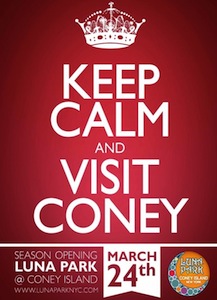
Coney Island’s Luna Park Reopens After Hurricane Sandy’s Mayhem

March 26, 2013

Following the reopening of Red Hook’s Fairway Market March 1—which was all but wiped out by October’s Hurricane Sandy—there’s more good news for the borough. Heights locals looking to hop the R train for Coney Island’s seasonal goodies now have an official green light. Last Sunday, the Luna Park rides reopened, after being washed over with 5 feet of seawater.

The BK Chamber of Commerce shares that “Coney Island’s colorful rides only just emerged from an extensive rehabilitation. Workers were still finishing the repairs when families began to crowd the entrances on Sunday morning.”

Alberto Zamperla, CEO of the firm that operates Luna Park, tells the New York Times, which covered the reopening, “Our commitment after the hurricane, from Day 1, was to be ready on time for this event.” The rehab included everything from replacing electrical systems to dumping go-carts brined in seawater.

In attendance for opening day were state Senator Charles E. Schumer and Brooklyn borough president Marty Markowitz.

Luna is one of two privately owned amusement parks that opened in Coney Island on Sunday. Much more in the NYT story.


Source: Brooklyn Heights Blog
http://brooklynheightsblog.com/archives/56753

From the Web

Books

Brooklyn Bugle Book Club: “The Leopard’s Tale: Revealing the Mysteries of Çatalhöyük” by Ian Hodder

March 22, 2013

The archeological site Çatalhöyük, in central Turkey, was the site of a large (33.5 acres) and populous (3000 – 8000 people) town. It was occupied from between 7400 BC and 6000 BC, almost too early to call it a town. There are 18 levels of occupation – people filled in old houses and then built on top of them. The site was first found and excavated in the late 1950s and early 1960s. Ian Hodder is a Stanford anthropologist who is leading the excavations underway now. “The Leopard’s Tale,” is Hodder’s effort to piece together the daily lives of the Neolithic people of Çatalhöyük based on the interesting but perhaps somewhat sparse artifacts that have survived.

There’s a lot the archeologists can tell from the site at Çatalhöyük. People stored grains in baskets. In the early, lower levels of the site, cooking was done by placing heated clay balls into the food; by the later period of the occupation, cooking was done in vessels that could be placed in or over stoves to be heated. The occupants buried caches of obsidian and later retrieved them. They entered their houses from the roof; the stairs or ladders were generally placed over the stove. Floors and walls were plastered and sometimes had painted decorations. Sometimes the inhabitants plastered over the paintings – replastering was done regularly, sometimes almost monthly.

The inhabitants of Çatalhöyük also did some things that we might consider taboo today. (Hodder is careful not to use value-laden words such as ‘strange.’) They incorporated animal skulls, particularly horned ones, into the walls of their buildings. They buried (or possibly re-buried) their dead underneath the floors. Infants and neonates were buried near hearths; older men and women were buried under platforms away from the stove.

But there’s a lot more we don’t know, and Hodder uses his book to outline what the inhabitants’ beliefs might have been. Objects were hidden and then recovered, and Hodder argues that hiding and revealing were the “main symbolic and ritual elaboration” of the town. Shells and beads were buried with the bodies of young children, but not with those of older people. Hodder says, “it seems more likely that the object placed with young individuals have more to do with some form of protection.” It’s fascinating, but necessarily highly speculative. And sometimes he builds speculation on top of speculation.

The title is a case in point. Leopard imagery runs throughout the book, as Hodder’s thesis is that leopards were important yet some taboo kept the inhabitants from bringing leopard remains (at least the kind that survive: skeletons, claws, and teeth) onto the site. It’s a puzzle, as there are many drawings and sculptures of leopards, and paintings of people wearing what appear to be leopard skins. And it makes for a nice theme. Unfortunately, while Hodder’s excitement about the site is evident, and his explanations of what the archeologists have concluded from the excavations are very clear, the book is filled throughout with a tendency towards scholarly jargon. So it’s an interesting if not an easy book to read. Did you think the speculative/knowledge balance was set correctly? Let us know what you think in the comments.

Have a book you want me to know about? Email me at asbowie@gmail.com. I also blog about metrics here.

From the Web

Brooklyn Heights

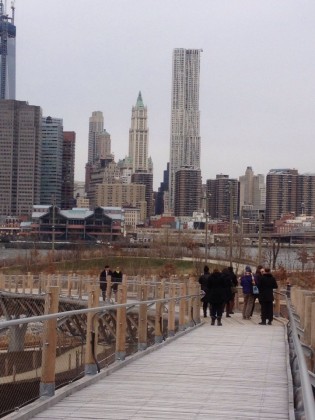
Squibb Park and Bridge Now Open in Brooklyn Heights

March 21, 2013

Squibb Park is now open, and I joined a few daring souls who took the first small steps over the BQE, taking into account the sign at the bridge entrance asked “Is That a Bounce in Your Step?”

I also joined a media event already in progress—a beaming Regina Myer posed for photogs, and designer Ted Zoli shared a few interesting facts with reporters about the bridge. When I’d watched it being built, it reminded me a bit of Swiss Family Robinson. But according to Zoli, the look was “adopted from techniques used in farming for a park setting.” This not only includes the wood, but the mesh wiring on either side. A few more interesting facts, courtesy of the designer:

—The bridge is made largely of a type of wood often seen on fence posts called black locust, which Zoli calls “indestructible.” It’s used throughout the park. As it ages it will turn from blond to gray. (As do many of us.)
—Although black locust is terrific structurally, it’s not often used because it’s not commercially cultivated.
—About 100,000 pounds of wood was used, which came mostly from Pennsylvania and Long Island.
—The spans were mostly prepared off-site and then set in rather quickly. The minimal need for a crane reduced the cost.
—Speaking of which, the total cost of the bridge was about $5 million.

So if you’re reading this post in time for your lunch break, ditch work have a look!

Gothamist was there too, took some photos, and shot this video:

A Walk Down Squibb Pedestrian Bridge from Gothamist on Vimeo.


Source: Brooklyn Heights Blog
http://brooklynheightsblog.com/archives/56589

From the Web

Landmark Preservation

Hotel St. George Sign Returns To Henry Street In Brooklyn Heights

March 20, 2013

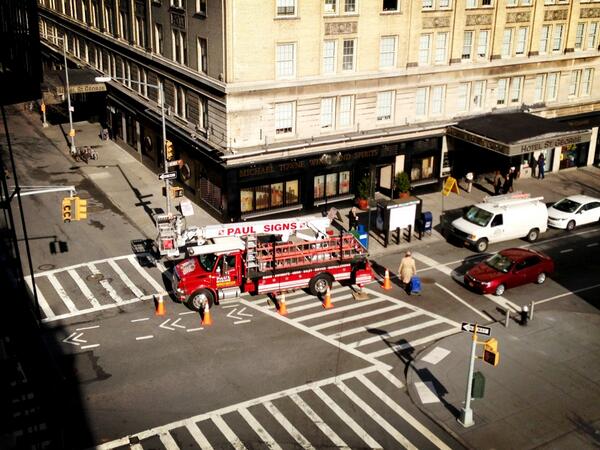
The iconic Hotel St. George sign on the corner of Henry and Clark Streets has been refurbished and returned to Brooklyn Heights this morning. Michael Correra at Michael Towne Wines and Spirits wrote us to say that the sign is looking great thanks to the hard work of the folks at Paul’s Signs.

BHB reader Chris Fohlin tweeted us a photo of the sign’s return this morning. Our Heather Quinlan is on her way to get more info….

UPDATE: And here I am, Heather Quinlan, with the latest sign news. According to Correra, “I think the sign is from 1933, though I don’t have any proof. What’s interesting is the man who repaired it said it had square bulbs, and they haven’t used square bulbs since the 1950s.” Correra also recommended a book New York Nights about the history of NYC signage. Featuring the Hotel St. George Sign, square bulbs and all.


Source: Brooklyn Heights Blog
http://brooklynheightsblog.com/archives/56534

From the Web